The first KIMAA black belt weekend class of 2016 was held at Turramurra Dojo on Saturday February 27th.
This class continued on from the Kyokushin black belt sessions last year in August and October. They are now scheduled shortly before the twice-yearly KIMAA seminars, designed to both consolidate knowledge among the seniors to ensure their students’ preparation is correct, as well as being advanced training for any seniors attempting a grading.
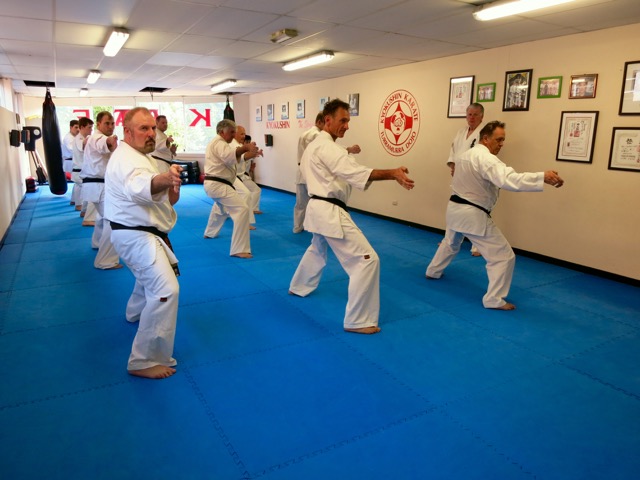
Three katas were practised: Saiha, Seienchin and Okinawan Seipai. Students then worked in pairs to go through the bunkai.
This slideshow requires JavaScript.
There were some sore bodies at the end of class from all the throws and takedowns – not to mention the wrist locks – but it was a successful class with a lot of focused content.
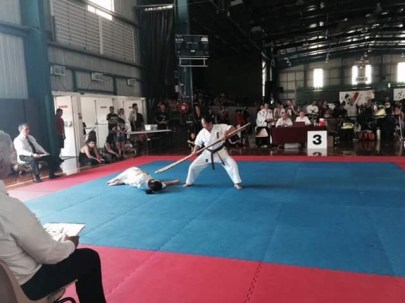
Senior Kobudo students fronted up to Annangrove Dojo the next morning for training, again with Sensei Mark and Sensei Jon in attendance. The Kobudo black belts revised Sakugawa No Kon (Bo), Arnis stick drill, Chatanyara No Sai (Sai) and Kudaka No Jo (Jo).
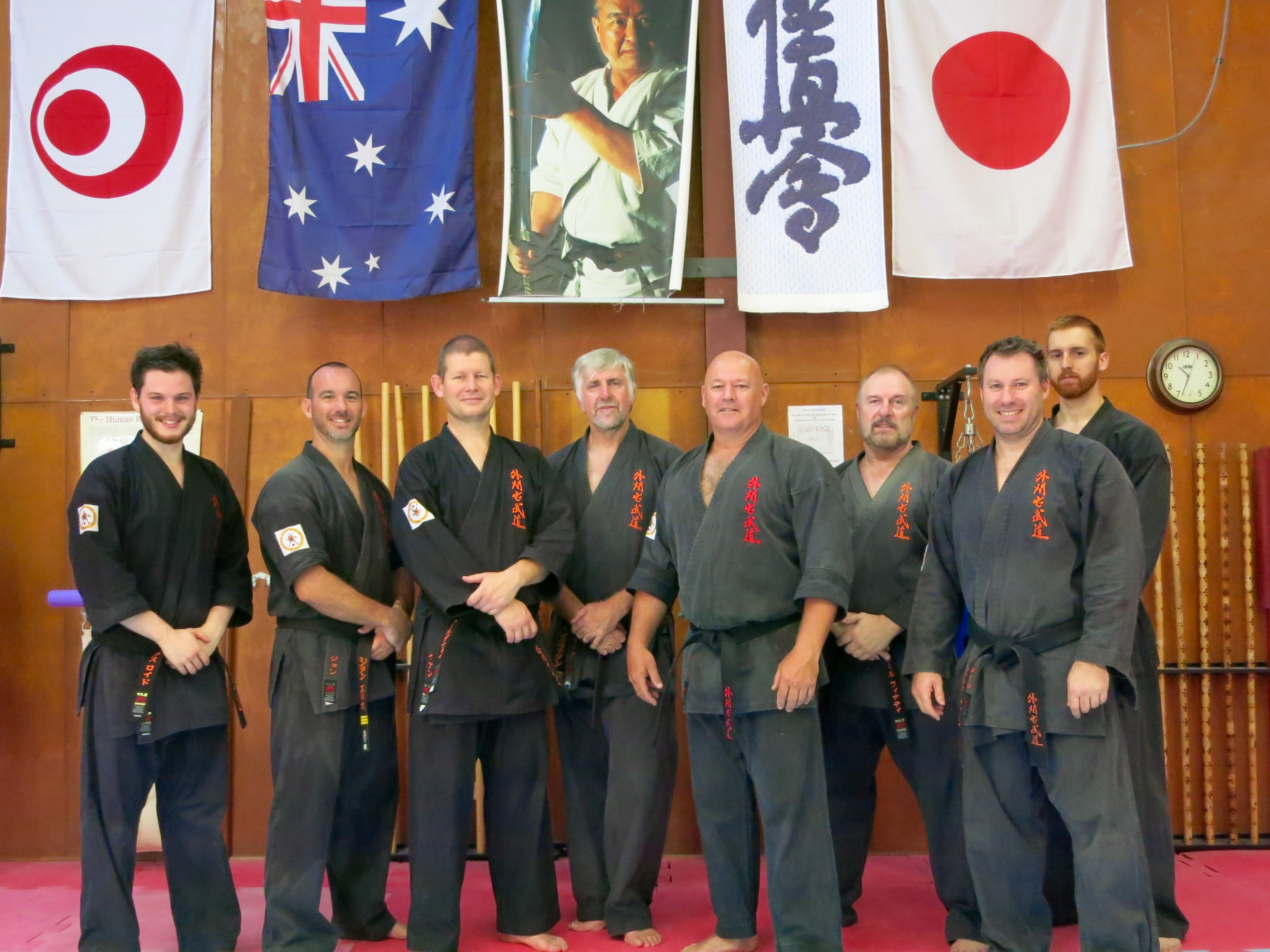
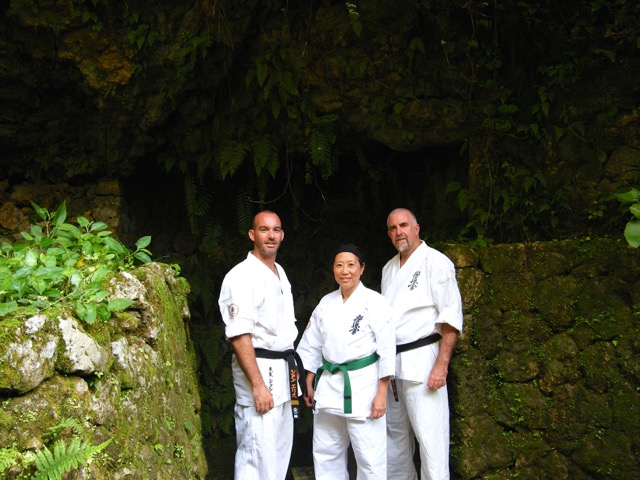
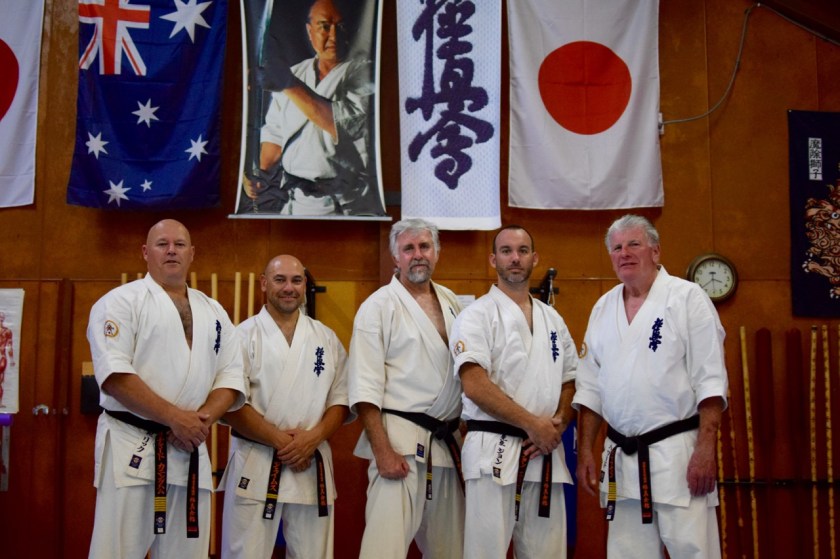
Sempai Alex Lloyd, Sensei Jon Ellis, Sensei Ian Holdaway, Sensei Mark McFadden, Shihan Rick Cunningham, Sensei Paul Finnerty, Sensei Mark Shelmerdine & Sempai James Campbell.
In January 2016, three KIMAA Yudansha received their new black belts. These promotions were awarded following the grading in November 2015. These new grades include:
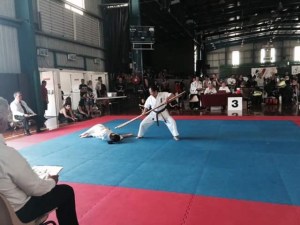
Sensei Hokama was most impressed with the standard displayed, and Shihan Ogura proclaimed he had never seen an international group as proficient in Kobudo as ‘the Australian team’.
A major highlight of not only the trip, but the entire year, was the 22nd Okinawan Karate Tournament in which Sempai Don and Sempai James competed. The tournament was hosted by Shihan Lipman’s old friend, Shihan Yasuhiro Shichinohe (7th Dan Kyokushin), whom KIMAA trained with in 2013. Don and James were the only international competitors at the tournament and admirably represented KIMAA. Sempai Don lost his first round while Sempai James made it to the quarter finals, finishing as one of the top eight in the Men’s Open division. Their coaches, Sensei Mark McFadden and Sensei Jon Ellis, were proud of Don’s and James’s efforts.
Okinawa (2015)
Okinawa (2015)
Okinawa 2015
Okinawa (2015)
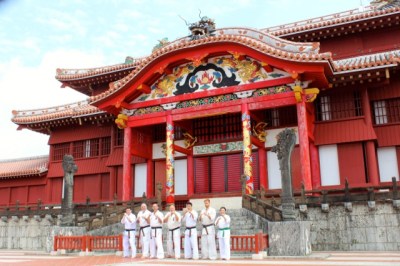
KIMAA at Shurijo, Okinawa.
Some more training with Sensei Hokama and Shihan Ogura followed, as well as exploring the sights of Okinawa. A ‘Kyokushin photo shoot’ was also undertaken by the tour group!
Sydney Kobudo students began the year preparing for the Japan trip. In addition to their normal Kobudo training, they also had a go at tameshigiri (trial by cutting) in January, cutting through mats with the kama and the sword, which they revisited in July.
Sensei Mark Shelmerdine teaches Kobudo at the May weekend seminar.
The first major KIMAA calendar event of 2015 was held by Shihan Howard Lipman (8th Dan Kyokushin, 7th Dan Kobudo) in Sydney. The weekend seminar of May 9-10 focused on Kyokushin basics, bunkai and Kobudo. The seminar ensured that the correct technical standard was being upheld throughout all KIMAA dojos.
Following on from the performance of Sempai Don and Sempai James in Japan, students from Turramurra and Annangrove dojos got into training for the NSW Kyokushin State Championship in May. All students fought well against their opponents. Special recognition goes to James Parasyn and James Kosimar for their wins, and to Victor Sweeney for coming equal Third in his division.
Shihan Howard Lipman, Victor Sweeney and Sensei James Sidwell
Yudansha Training Weekend
Seienchin Kata
As winter set in, eyes turned to the combined senior grading and seminar later in the year. Training intensified throughout KIMAA. Yudansha (black belts) from all dojos came together for a weekend of training together in August. This included Kobudo training on the Saturday afternoon, and an intensive kata session on the Sunday, both at Shihan Cunningham’s Annangrove Dojo.
Men’s Open Middle Weight champions.
Soon after the Yudansha weekend, many students from Turramurra and Annangrove competed in the IFKKA Tournament on Sunday September 6. KIMAA dominated the event, its students winning many placements and medals. KIMAA took the top three spots in the Men’s Open Middle Weight: Sempai Don Cheong (First), Sempai Ben Ng (Second) and Sempai Alex Lloyd (Third); Kasra Parsanejad came First in his division; and Andy, Elia, Christian, Jasper, Bernard and James came Second or Third in their respective divisions.
To further their efforts, a senior kata session was held by Shihan Lipman at Turramurra Dojo. Black belts from Turramurra, Annangrove and Ballina Dojo were in attendance. Shihan Lipman and KIMAA’s technical director, Sensei Peter Olive (4th Dan Kyokushin, 1st Dan Kobudo), were satisfied that the overall technical standard of the black belts has never been higher.
The first night of the seminar, on a Friday, was held at Turramurra Dojo. Ray, a Krav Maga instructor, taught at Shihan Lipman’s invitation. Students were given an introduction to basic self-defence against an opponent with a gun, and an opponent with a knife. The students enjoyed learning some new skills.
The Kyokushin seminar began on Saturday morning at Annangrove Dojo. Adult and Little Lion attendees from all five KIMAA dojos, including Knox Karate, participated on the day. Kihon (basics), Sanbon Kumite (three-step sparring) and bunkai were revised extensively during the morning. In the afternoon the tameshiwari (board breaking) component of the grading was undertaken, including some impressive multi-breaks by Sempai Ben and Sempai Don, and four-board breaks with seiken (forefist) and shuto (knifehand) by Sempai Wally Gray. The day finished with fight training.
Sunday November 1 saw the senior grading take place. Sensei Peter led the class while Shihan Lipman and Shihan Cunningham assessed the students. The senior Kyu grades and black belts attempting the grading were Sempai Ben Ng, Sempai Don Cheong, Sempai Wally Gray, Josh Darley, Victor Sweeney, Patricia Tan and Jermaine Downs. During the long session, Kyu grades and black belts not grading broke up into groups for specialised training, led by Sensei Paul Finnerty (4th Dan Kyokushin, 3rd Dan Kobudo), Sensei Mark Shelmerdine (4th Dan Kyokushin, 4th Dan Kobudo), Sensei James Sidwell (4th Dan Kyokushin, 1st Dan Kobudo) and Sempai James Campbell (2nd Dan Kyokushin, 2nd Dan Kobudo).
Sensei Don Cheong performs tameshiwari.
After a hard morning, the grading was over. Congratulations are once again extended to all who participated, especially the new Dan grades: Sensei Ben Ng (3rd Dan Kyokushin), Sensei Don Cheong (3rd Dan Kyokushin) and Sempai Wally Gray (2nd Dan Kyokushin).
Essential to the success of both seminars were Shihan Cunningham’s wife Kirsti, Sensei Mark McFadden and Sensei Ian Holdaway (3rd Dan Kyokushin, 1st Dan Kobudo), who kept everyone well fed!
A new KIMAA video was also released during the year, using footage from 2014 and 2015. Thanks go Sempai Alex Lloyd (2nd Dan Kyokushin, 1st Dan Kobudo) and Jonathan Lee for the extensive photography and video work throughout the year, and all other contributors.
KIMAA students from Sydney competed in local, state and international tournaments, smashed through new personal bests in challenges such as board breaking, and raised the standard of their weapons and kata to a whole new level.
The success of Sydney students in these tournaments reflects the quality tournament training. For Turramurra and Annangrove students, particular thanks for this goes to Shihan Lipman, Shihan Cunningham, Sensei Mark Shelmerdine and Sensei James Sidwell. However, it also reflects the hard work and positive attitude of the students, many of whom only fought in their first tournament in the last two years.
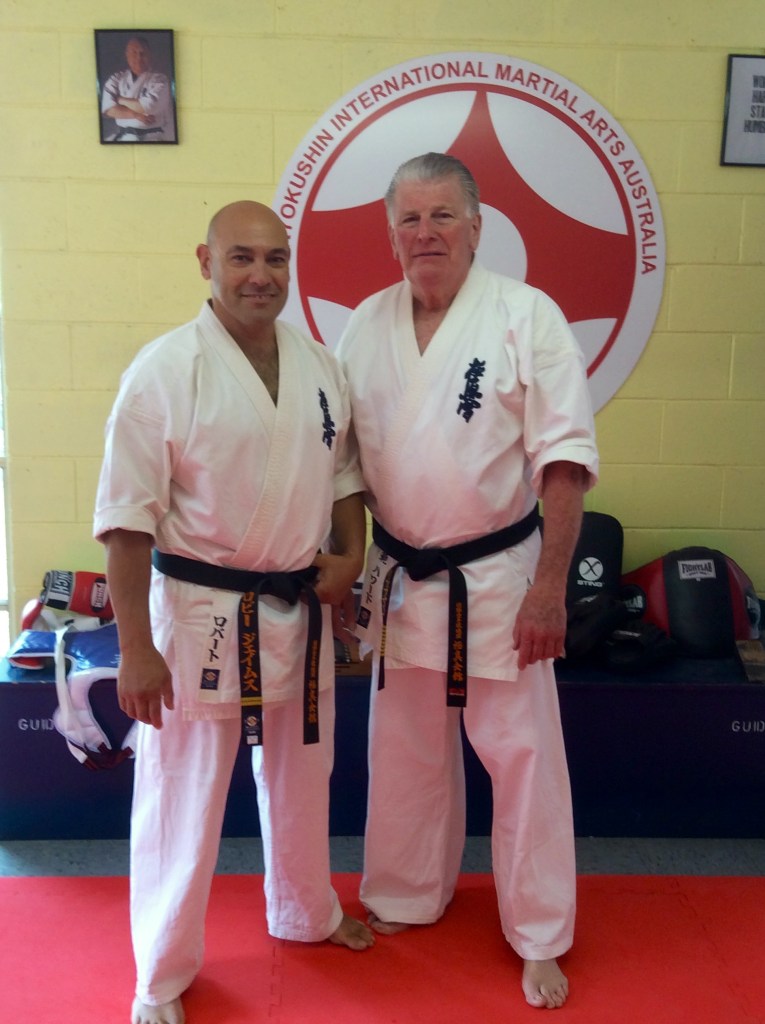
KIMAA Black Belts: Mark McFadden, Rick Cunningham, Paul Finnerty, Jon Ellis, Rob James, Ben Ng, Howard Lipman, Don Cheong, Alex Lloyd, Mark Shelmerdine, James Campbell, Mark Long, Peter Olive & James Sidwell.
Far North Coast, NSW
Sensei Jon and Sensei Mark with their fighters, James and Don.
KIMAA students of Lismore and Ballina dojos had a busy year, particularly in tournaments.
Early in the year, three karateka from the North Coast were part of the Japan group tour. Sensei Mark McFadden (3rd Dan Kyokushin, 3rd Dan Kobudo) and Sensei Jon Ellis (3rd Dan Kyokushin, 2nd Dan Kobudo) returned to Japan to once again train with Sensei Hokama. Patricia Tan also partook in her first KIMAA trip to Japan.
During this trip, Sensei Mark and Sensei Jon were graded to 3rd and 2nd Dan in Kobudo respectively, as well as coaching Sempai Don and Sempai James in the tournament.
Sensei Jon & Sensei Mark at Nakagusuku
Jon, Trish and Mark at Nakagusuku
Trish & Sensei Hokama
Karateka from Lismore and Ballina trained at the May Sydney seminar, displaying an exemplary standard of technique.
The North Coast held its own seminar in July. Shihan Cunningham taught at the seminar, with Sensei Mark and Sensei Jon also leading instruction. The seminar expanded upon the bunkai work looked at in previous seminars, both in Sydney and held at Lismore. The seminar concluded with a Kobudo grading.
Sensei Mark McFadden at the Yudansha Training Weekend.
Little Lions and adults competed in various local, state and national competitions throughout 2015, with the National All Styles and other organisations.
KIMAA competitors at the NAS QLD State Titles.
For the NAS competitions, students had to complete a qualifying round before being able to enter the state competition. Students who had qualified competed in the NAS Queensland State Titles in October.
Many trophies were won, but as Sensei Mark told his students, ‘It’s not the trophies – it’s the participation, it’s overcoming the fears of getting up in front of everyone or standing up to fight someone. Osu and well done.’
In between all the tournament training, practising kata and Kobudo continued. Students regularly attended weekend classes, always geared to prepare for the next major seminar, grading or tournament, or just for regular weapons training. Sensei Mark attended the August Yudansha Training Weekend at Annangrove Dojo, and Sensei Jon flew down for the October Senior Kata Training at Turramurra Dojo.
Instructors and students from the North Coast dojos once again travelled to Sydney in October for the combined seminar and grading. Sensei Mark, Sensei Jon, Sempai Wally Gray, Jeremy Gray, Trish Tan and Ben Brady made the journey. Sempai Wally, Trish and Ben attempted the grading and performed very well in what was a long weekend. Sempai Wally received his 2nd Dan, Trish her 2nd Kyu and Ben his 3rd Kyu.
Ben
Trish
Wally
Trish and Amanda perform their Creative Weapons demo.
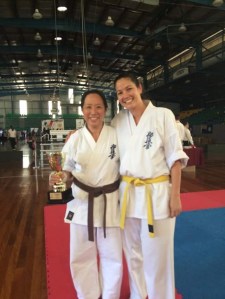
The efforts of the North Coast karateka at the NAS throughout the year culminated in the Australian Championships, held on the Gold Coast. Many students from Lismore, Ballina and Aspley competed. Trish Tan and Amanda Bolger had a particularly long day, pairing up in multiple partner demonstrations and also fought each other. In the end KIMAA had 3 Thirds, 2 Seconds and a First place in the National All Styles.
The North Coast karateka know the meaning of persistence. After a two day competition on six mats the previous weekend at the NAS, the following weekend saw Lismore and Ballina come together for a grading. Sensei Mark and Sensei Jon put the students through the ring but most came out not too battered and bruised on the other side.
Lismore and Ballina students, like their Sydney counterparts, had a strong year in tournaments. The challenge to push yourself to your own limits and be the best you can be was a driving force in the long hours of consistent training undertaken by the North Coast karateka. This mental fortitude translated into other Kyokushin pursuits, such as gradings, further developing the quality of martial artists from Sensei Mark’s and Sensei Jon’s dojos.
North Coast December Grading.
Brisbane, QLD
IKO State Titles, April 2015.
Students of Aspley Dojo continued to develop their kata and bunkai knowledge through internal competitions, particularly among the Aspley Little Lions. Under the instruction of Sempai Rob James (2nd Dan Kyokushin) they also continued their rigorous tournament training, with competition participation at an all-time high from KIMAA’s only Brisbane dojo.
The first major competition Sempai Rob’s students competed in was the Queensland IKO State Titles in April. KIMAA walked away with three medals.
Sempai Rob was ‘extremely proud’ of all of his students, ‘not just the ones who came away with a medal. You all worked hard on the day and displayed great spirit and determination.’
Students of Aspley Dojo continued to build a strong relationship with the students of Lismore and Ballina dojos throughout 2015. Sempai Rob and students teamed up with the North Coast for training weekends, competitions and seminars, including the North Coast July Seminar. Queensland karateka also made their way to Sydney for the May seminar.
Amanda Bolger paired with Patricia Tan from Lismore for a partnership entry in two demonstration events: Creative Weaponry Demo and Creative Form Demo.
Amanda and Trish demonstrated their proficiency in Kobudo, coming First in both categories. Amanda also placed Second in her Points Sparring division and Fourth in Individual Kata.
The young Aspley Little Lion Jack Bolger also did his dojo and instructor proud. Jack represented KIMAA by competing in the Continuous Sparring 7-9 Years. Jack was eliminated in the first round, but he returned to fight in the Points Sparring 8-9 Years. He won one round. This was Jack’s first tournament and he exhibited excellent character and endurance to face up after a loss and keep pushing. Jack is one of many of Sempai Rob’s budding young martial artists.
By the end of October, it was time for the Queensland crew to return to Sydney for another KIMAA event, the seminar and grading. Jermaine Downs, Hieu Hoang and Chris Mitchell came to attempt the grading, and of course Sempai Rob came to support his students and partake in the seminar. They all passed the grading and advanced to their next Kyu grade, which for Jermaine is 2nd Kyu (brown belt).
Jermaine
Hieu
Chris
Sempai Rob and Shihan Lipman lead the Karate class.
Sempai Rob James with Shihan Howard Lipman, KIMAA Chairman.
Shihan conducted several sessions with the adults and Little Lions, focusing on basics, ido geiko, kata and self-defence techniques. For the students who had not had the opportunity to travel to Sydney before, it was a great experience to be taught by Shihan Lipman.
KIMAA’s head instructor emphasised to all the meaning of Kyokushin, the pursuit of the ultimate truth, and doing so as per the teachings Shihan learned from Sosai Oyama.
‘Aspley has had a very successful year, going from strength to strength. Students’ knowledge is improving as is their technical ability, and the support I receive from both adult students and parents of the Little Lions is humbling. I believe in building the people before the dojo and, as a result, we have a solid core of students both in the Adults and Little Lions who work hard and have a positive “can-do” attitude.’ – Sempai Rob James on 2015 for Aspley Dojo.
The quality of Sempai Rob’s instruction is reflected in the strength of a young dojo, a dojo that is a firm part of the KIMAA family.
Aspley Dojo adults with Shihan Lipman.
Aspley Dojo Little Lions with Shihan Lipman.
Closing Remarks
KIMAA Dojo Operators: Shihan Rick Cunningham, Sempai Rob James, Sensei Mark McFadden, Sensei Jon Ellis & Shihan Howard Lipman.
2015 was undoubtedly a triumph of a year for Kyokushin International Martial Arts Australia. Success in all tournament levels, new highs in Kobudo, sharper kata and a deepened knowledge of bunkai continue to develop among KIMAA’s martial artists, regardless of age or gender. Everyone saw the challenges their fellow students were setting themselves – gradings, tournaments, overseas trips – and aspired to improve themselves, emulating their peers, and achieved just that. Well done to all KIMAA students on a terrific year.
Our thanks goes, as always, to the dojo operators and other instructors who set the tone and culture of KIMAA, maintaining a competitive but friendly learning environment where each student is challenged to do their best. Shihan Lipman, Shihan Cunningham, Sensei Mark, Sensei Jon and Sempai Rob run dojos of which every student is delighted to be a part.
Enjoy the holiday season and see you all in 2016. Osu!
Shihan Rick Cunningham & Shihan Howard Lipman, November 2015.
On the weekend of December 5-6, the National All Styles Australian Championships were held on the Gold Coast. Competitors came from New South Wales, Victoria and South Australia. The competition ran over two days on six mats.
To qualify for the nationals they all had to go through a qualifying round, then the Queensland State Championships and then be invited to participate in the nationals.
Cooper, Isaac and Ayla were in the under 7, Peewee division. Cooper fought a black belt in his first round and won.
Conrad and Brad were in the 8 to 9 years division. Brad did well, losing in an extension. Conrad placed Third.
Wes was in one of the largest divisions, the 16-year-old male 5th Kyu and above. This meant he was fighting and doing kata against black belts.
Trish performs Seienchin kata.
Amanda and Trish teamed up to do a demo kata with applications and came Second.
They teamed up again in the Creative Weapons section and came Third.
Amanda and Trish were also in the Women’s Advanced Kyu grade sparring, and unfortunately drew each other first up. It was a close match which Trish won.
Trish then went on to fight twice more and came Second in an extension. It was later discovered she had broken her thumb in the first match. Trish fought three rounds with the broken thumb – the power of the Kyokushin spirit and adrenalin!
The highlight was Trish winning the Women’s Open Kata division, performing Seienchin (which is in the KIMAA syllabus for 3rd Dan black belt). As the first competitor she had the option to do the kata again. She was told she was placed Second but if she did the kata again she would risk getting a lower score. She risked it all, with Sensei Jon Ellis telling her she could do a better kata. She did and placed First.
Trish and Amanda also were asked to compete in the Victorian team for the state against state competition, and were placed Third.
KIMAA’s Little Lion champions!
In the end KIMAA had:
3 Thirds,
2 Seconds and
a First place in the Australian National All Styles.
Congratulations to all who competed. It took a lot of hard training and effort in previous competitions to qualify for the nationals. Not only did these students make the journey to reach this point, they all were excellent ambassadors for KIMAA and did their karateka proud. Special congratulations to those who won a placement. Thanks go to instructors Sensei Mark McFadden, Sensei Jon Ellis (3rd Dan Kyokushin, 2nd Dan Kobudo) and Sempai Wally Gray (2nd Dan Kyokushin) for their continued teaching, support and mentorship in Kyokushin and Kobudo.
On the weekend of November 28-29, my wife Masumi and I travelled to Brisbane for me to conduct a seminar at Sempai Rob James’s (2nd Dan Kyokushin) dojo in Aspley. There were 15 kids and 12 adults in attendance over the course of the weekend.
Sempai Rob and Shihan Lipman lead the class.
Aspley Dojo Little Lions with Shihan Lipman.
On Saturday afternoon the first class was for the kids who were initially a little apprehensive, however they were soon made to feel at ease and settled down to enjoy their class. I was most impressed with their level of knowledge and attitude towards training. The class consisted of Kihon, Ido Geiko and Kata.
Personalised belts
At the conclusion of the class, Masumi wrote all the kids’ names on their belts in Japanese, which they thought was great.
This class was followed by a session with the adults where once again I checked and emphasised the importance of basics. Most of the class was spent on Kihon and Ido Geiko. Both were at a good standard, which is always a measure of capable students and a quality and dedicated instructor.
On Sunday morning there was another class for the adults and this was orientated towards Ido Geiko, Kata, some fighting techniques and a little self-defence. All the adults performed well and have potential to move forward in their grades.
A few deserve special mention: Jermaine and Amanda, the senior kyu grades, are excellent role models for the more juniors. Chris and Yolanda from the junior kyu grades also performed exceptionally well.
Aspley Dojo adults with Shihan Lipman.
All the adults also had their names put on their belts in Japanese by Masumi.
The seminar was a great success and enjoyed by all. Congratulations are due to Sempai Rob, who I have known since he was 17 years old. It has been interesting and pleasing to watch his progress over the years. His dojo now is well organised and well disciplined which is a mark of the man himself.
Although often taken for granted, our eyes guide us throughout our lives. From when we wake up in the morning, to the moment we fall asleep, we look, we see, and we do. The importance of our eyes and the sense of sight extends to karate, and the karateka (karate student) must train them well. Visual focus is the foundation of posture and balance. It provides a frame of reference and is critical to both focus and general alertness. The karateka must never forget their eyes in training, in particular kihon (basics), ido geiko (moving through in stance), kata (formalised pattern or form) and kumite (sparring).
1. Kihon
Jermaine demonstrates excellent visual focus while practising kihon.
When one begins training in karate, they begin with basic training, known as ‘kihon’. The white belt is instructed on posture and balance as a foundation of their training. While developing posture and balance, the karateka must focus their eyes correctly. In kihon, the karateka must look ahead at eye level, and not down at the ground. Looking ahead ensures the body is upright, chin held high and back straight. This helps open the chest for breathing, allows for proper tensing of the core and ensures that energy is flowing freely from the ‘hara’ (reservoir of energy located below the navel). If the karateka is to look at the ground, their posture and balance will be poor, their breathing hindered and internal energy flow restricted. The eyes must therefore be trained well in kihon.
Some more advanced kihon involve circular techniques, such as ‘mawashi geri’ (roundhouse kicks) and ‘ushiro mawashi geri’ (reverse roundhouse kicks). With the added movement in these techniques, positioning of the eyes is even more crucial in maintaining posture and balance. The eyes must look forward at all times. With spinning kicks, the eyes lead the execution. The head turns first to enable the eyes to lock on to the imaginary opponent in front of them, which establishes a frame of reference for the body and leg to follow for the remainder of the kick. Without this focus (‘kime’), the technique will lack balance, and without this kime, the body has no frame of reference from which to execute techniques. The mastery of advanced karate techniques is difficult to achieve without training of the eyes.
2. Ido geiko
Victor and Josh use their eyes for ido geiko.
The next stage of karate training involves moving through in different stances and executing various techniques, otherwise known as ‘ido geiko’. The eyes again play a vital role. Ido geiko involves moving up and down the dojo, always with a turn or ‘mawatte’ at each end. The head and eyes must lead the turn for balance and in particular, for the karateka to see the imaginary opponent behind them before turning. More advanced ido geiko training involves moving in ‘kaiten’ and ‘sagari’ (‘turning around’ and ‘turning retreat’). It is critical, as with the mawashi techniques, that the eyes lead the turn and lock onto the front position before the remainder of the turning around or turning retreat is executed. The eyes must therefore be trained well in ido geiko.
3. Kata
Sensei Don shows how using the eyes is essential for balance and correct technique in kata.
In karate, one of the key training foundations is ‘kata’. Kata combines posture, balance and technique in a formal pre-arranged pattern. As the eyes improve proficiency in these three aspects, as discussed above, kata also requires correct visual focus. Karateka are always taught to ‘look first’ when they begin their kata. While this teaching is usually explained by the importance of seeing one’s opponent, ‘looking first’ is also critical in ensuring the eyes are focused on a position, establishing a frame of reference and enabling the rest of the body to follow, so the technique is executed with balance. This is even more important with kata performed in ‘ura’ (spinning around). Leading the kata with the eyes also creates intention in the movements, making the direction of the movements clear and forecasted. The eyes must be trained well in kata.
4. Kumite
Sensei Don uses his visual focus to land a blow in kumite.
One of the physical ultimates of karate is ‘jiyu kumite’ (free sparring). The eyes are critical in kumite to ensure the whole of the opponent is visualised. There is some debate about exactly where the eyes should look, however focusing on the region between the chest and the opponent’s eyes is generally accepted. Focusing on this area allows the karateka to see, in their peripheral vision, the whole of the opponent. This general alertness or remaining spirit is known as ‘zanshin’. The correct visual focus and zanshin allows for instantaneous detection of any body movement by the opponent, whether it is the initial stages of a kick, a punch or a flinch that may signal the initiation of a technique. Conversely, focusing the eyes on an opponent’s hands or legs will result in a failure to detect movement in other parts of their body, therefore creating blind spots. Correct visualisation with the eyes is critical in kumite and must be trained well.
Applications of visual focus beyond karate
The importance of correct visual focus extends beyond karate, into many other disciplines and sports.
Correct visual focus transfers into other sports and disciplines, as Sempai Alex shows here in Kobudo.
When a beginner is taught to ski, snowboard or wakeboard, they are instructed not to look down at their skis or snowboard, and instead to look up at where they wish to go. Similar to karate, the rationale behind this is to ensure correct posture. In skiing, without the correct posture, weight distribution on the skis will be wrong and will impede control of the skis. In wakeboarding, focusing the eyes on the wakeboard will result in a downward looking posture, which will result in a nose-dive crash.
Another reason why in skiing (and many other high-speed sports) one is taught to focus on where they wish to go, is that the body will naturally orientate towards their point of visual focus. Conversely, if an obstacle is to be avoided, visual focus should not be on the obstacle, otherwise the body will naturally orientate towards the obstacle and will result in a collision. Similarly in mountain biking, when a rider must traverse a gully by crossing a narrow bridge, the rider must not focus on the gully below the bridge, otherwise they will inevitably end up in the gully.
In horse riding, balance and neutral body position is crucial. Horses are trained to respond to the slightest change in the rider’s posture. Slightly leaning forward or back is interpreted by the horse as a command to speed up or slow down. Maintaining a neutral body position is therefore important to avoid an unintentional command. A novice horse rider will be taught to look up in the distance at where they wish to go, which maintains the correct body position. They will also constantly be reminded not to look down at their hands holding the reins or at the horse’s head, as these will cause a forward leaning posture, sending an undesired command to the horse. Correct visual technique is vital in all of these pursuits.
Mokuso – absence of visual focus
Students reflect at the end of training.
Another important part of karate is ‘mokuso’ or meditation, at the beginning and end of training. During mokuso, the karateka closes their eyes and focuses on the training they are about to embark upon or reflects on the training they have just undertaken. In the context of this essay on the importance of correct visual focus, closing of the eyes may seem contradictory. This is not the case. Mokuso does not involve looking outwards, but instead is a practice of looking inwards, and translated literally, means ‘looking into the heart’. This practice of introspection is aided by blocking out all distractions and therefore warrants closing the eyes. This is the only instance in karate when visual focus is not necessary, and the closing of the eyes is required.
Closing
If you see, your body will follow.
Correct visual focus must be trained well in karate. It ensures good posture and balance, assists with breathing and energy flow, provides a frame of reference, guides movements, and provides perceptive vision when sparring. Proficiency in many other sports also requires correct visual focus. When problems arise in training, you (the karateka) should consider and analyse your position and technique, but most importantly, you should think about your eyes. Are your eyes focussing in the right direction? Are you leading your body with your eyes? Are you allowing your eyes to see the whole picture?
A widely read and respected book on personal improvement, The 7 Habits of Highly Effective People, written by Stephen Covey, pronounces the importance of envisioning what you want to achieve in the future, so that you know clearly now what to make a reality. It is known as the 2nd habit: ‘begin with the end in mind’. This is important in all aspects of life. In karate, one must ‘begin with the end in sight’. If you see, your body will follow.




























 Kyokushin International Martial Arts Australia