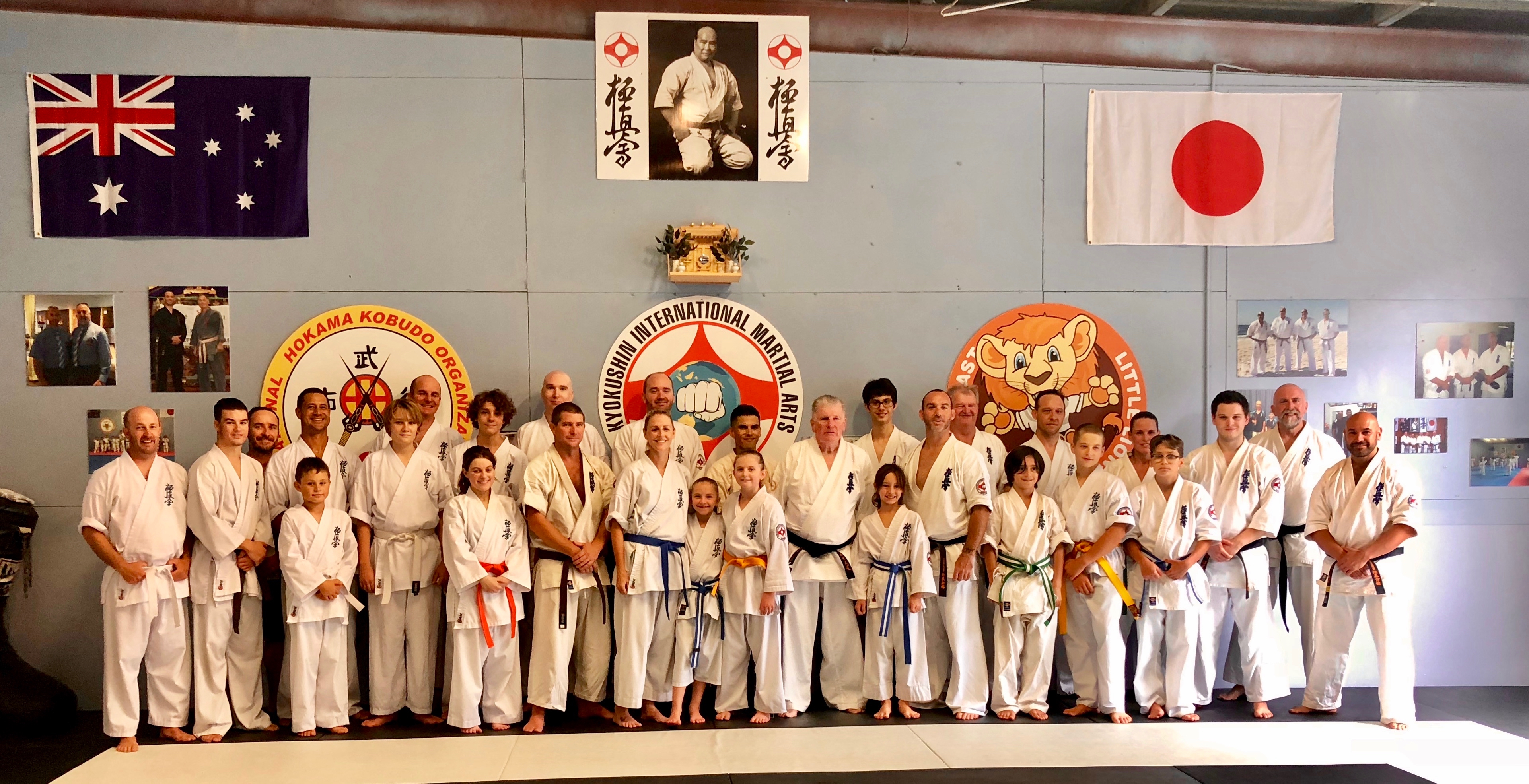
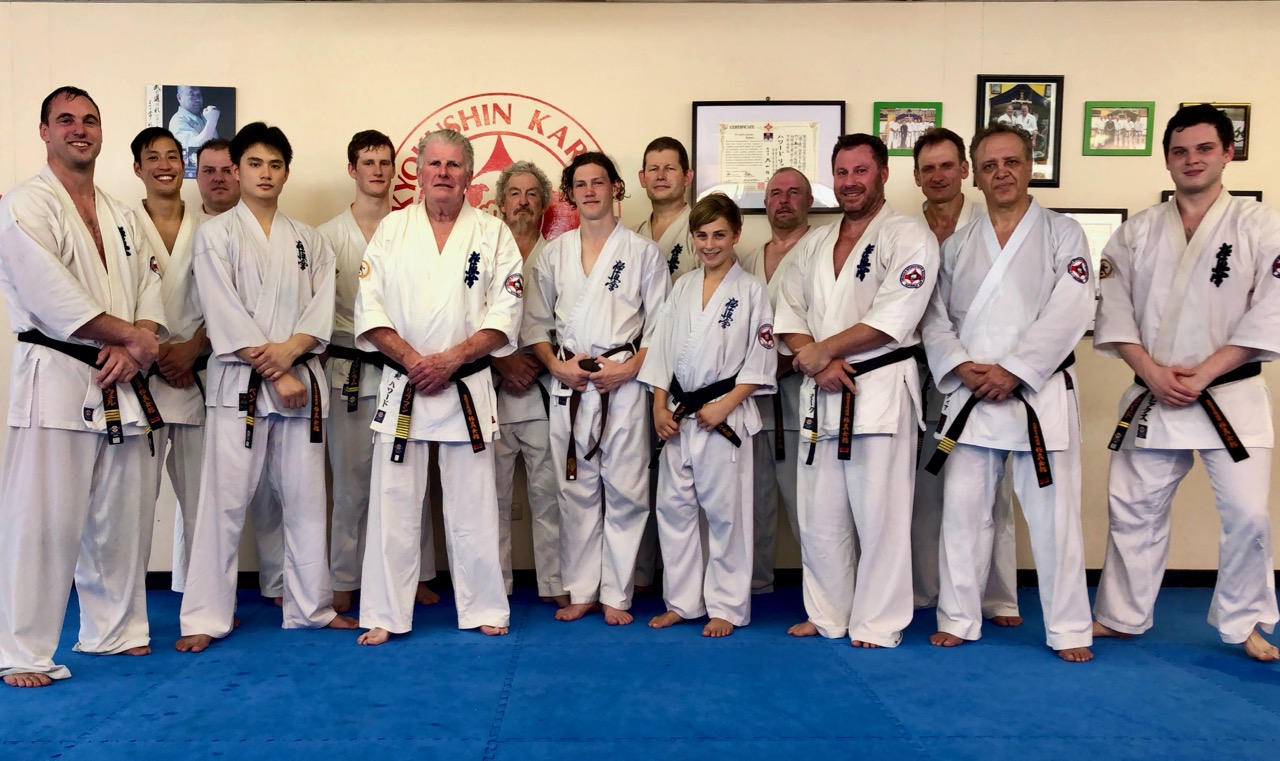
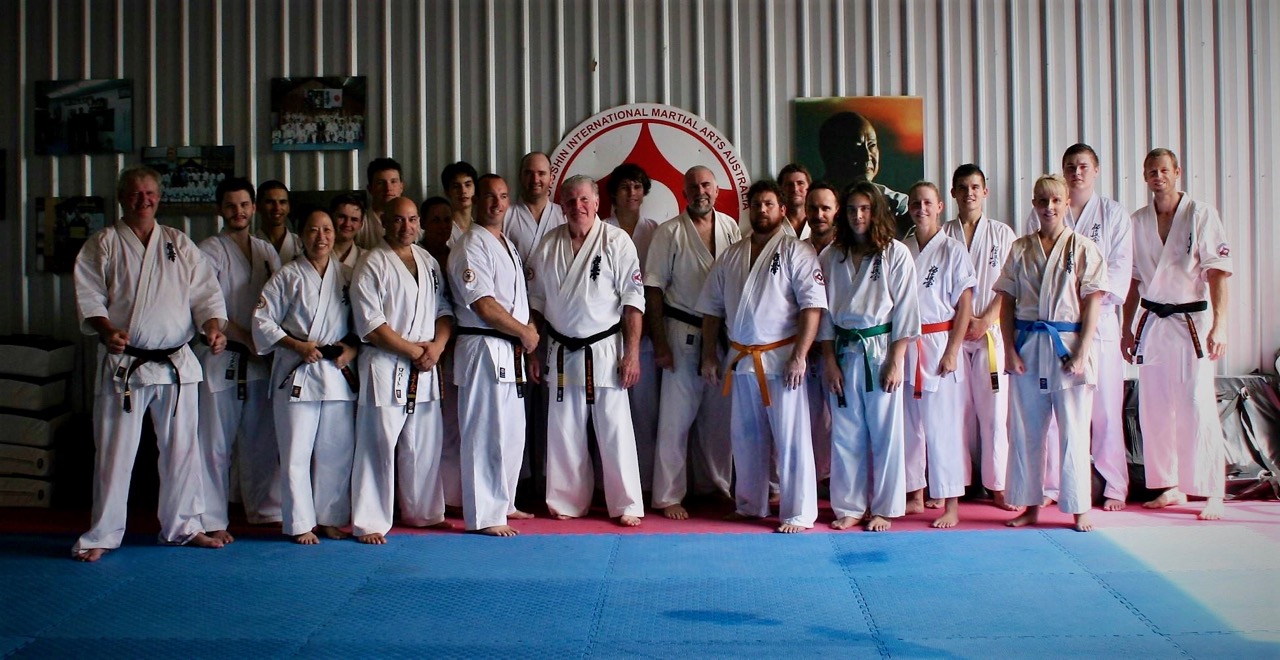
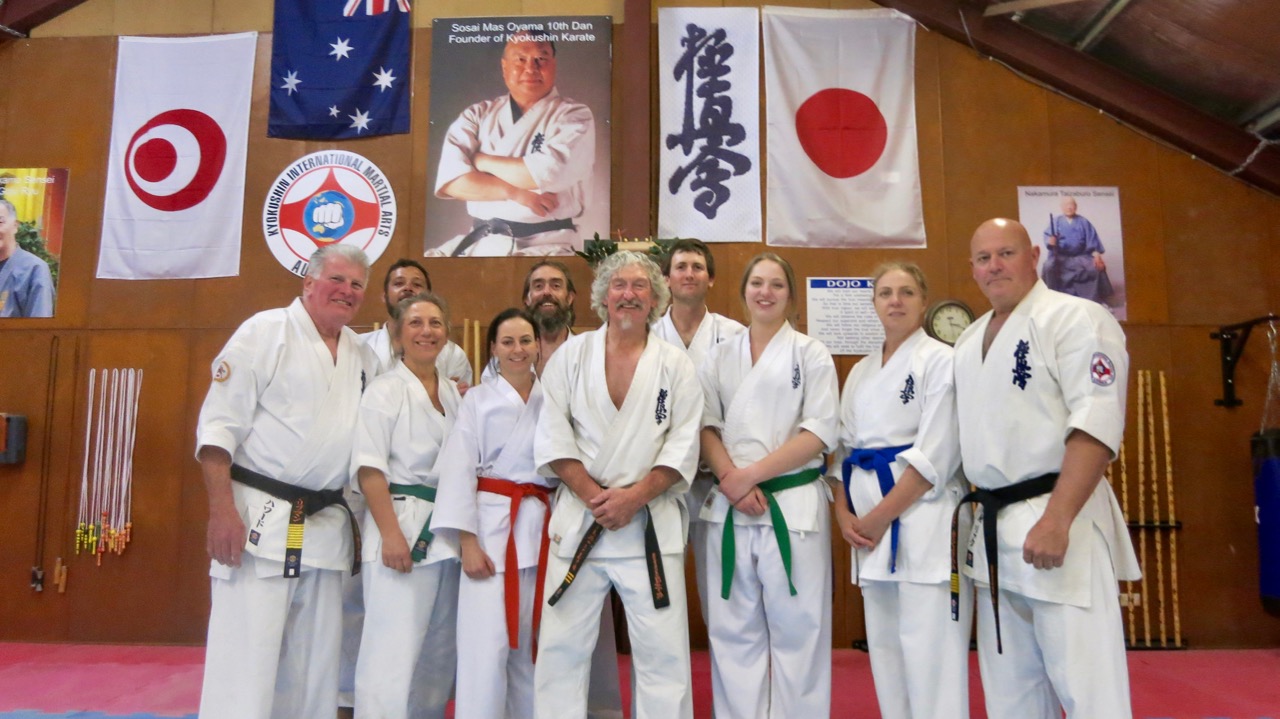
Seminar black belts: Sempai Wally Gray, Sensei Jon Ellis, Hanshi Howard Lipman, Sempai Alex Lloyd, Sempai Patricia Tan and Sensei Rob James.
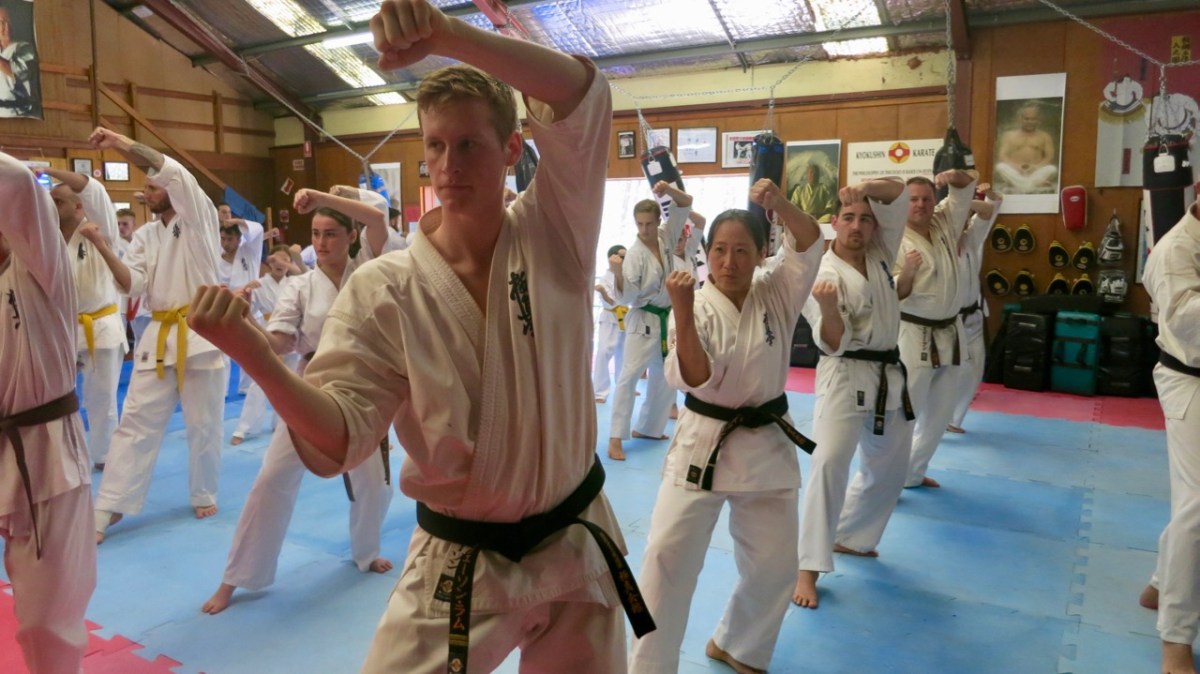
Saturday morning kicked off at Sensei Jon’s Ballina Dojo. Adults and Little Lions came together to for the general class in kihon (basics) and kata (pattern) under Hanshi. Strikes, blocks and kicks were practised at length, examining the finer points of each technique. The students gained a new appreciation for how much goes into every aspect of Karate. They next applied these tips for technical precision into fighting drills. The class also performed some kata, and learned new partner-stretching moves.
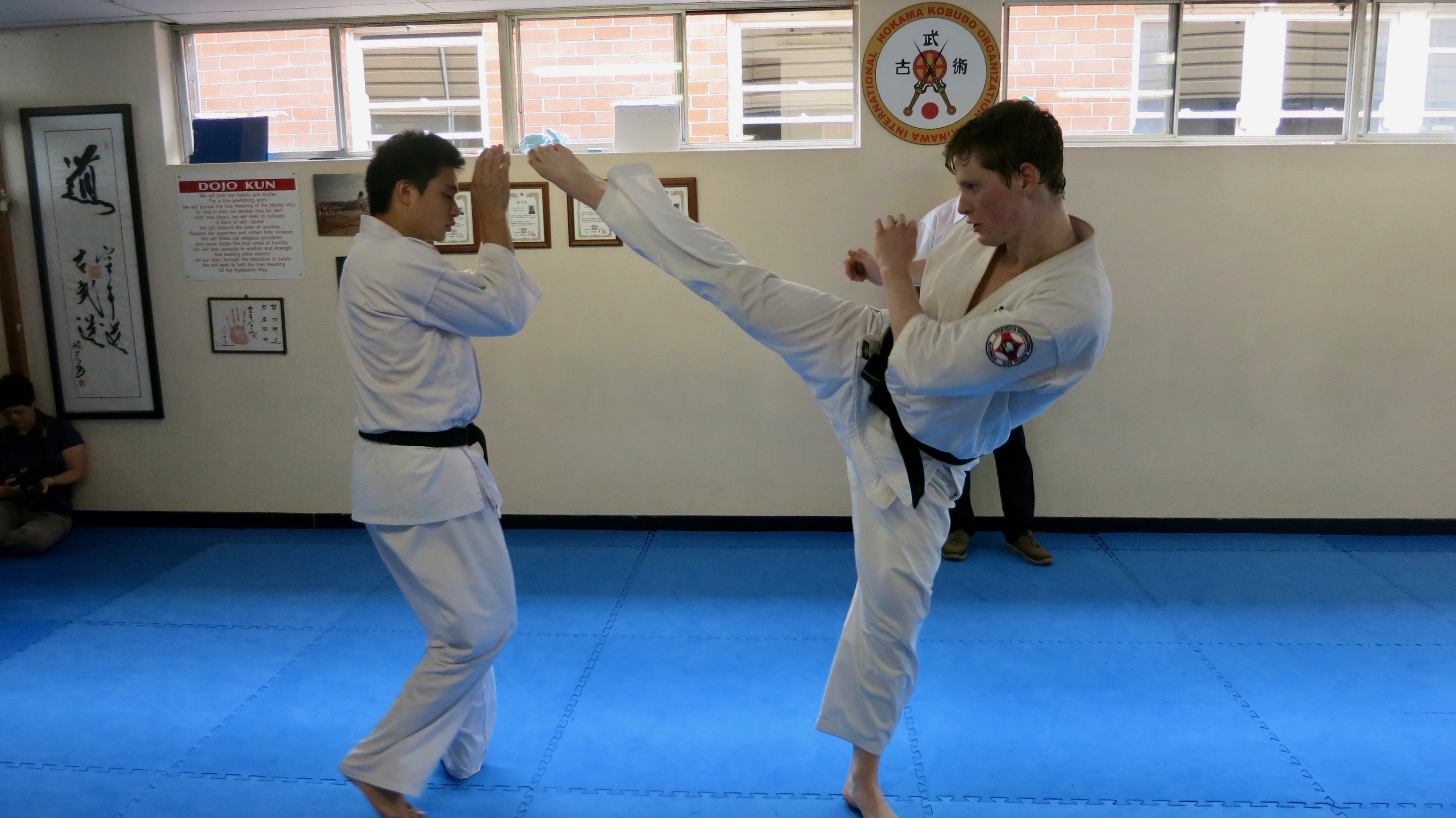
Wesley Snider of Lismore Dojo tests his flexibility in the North Coast KIMAA Seminar.
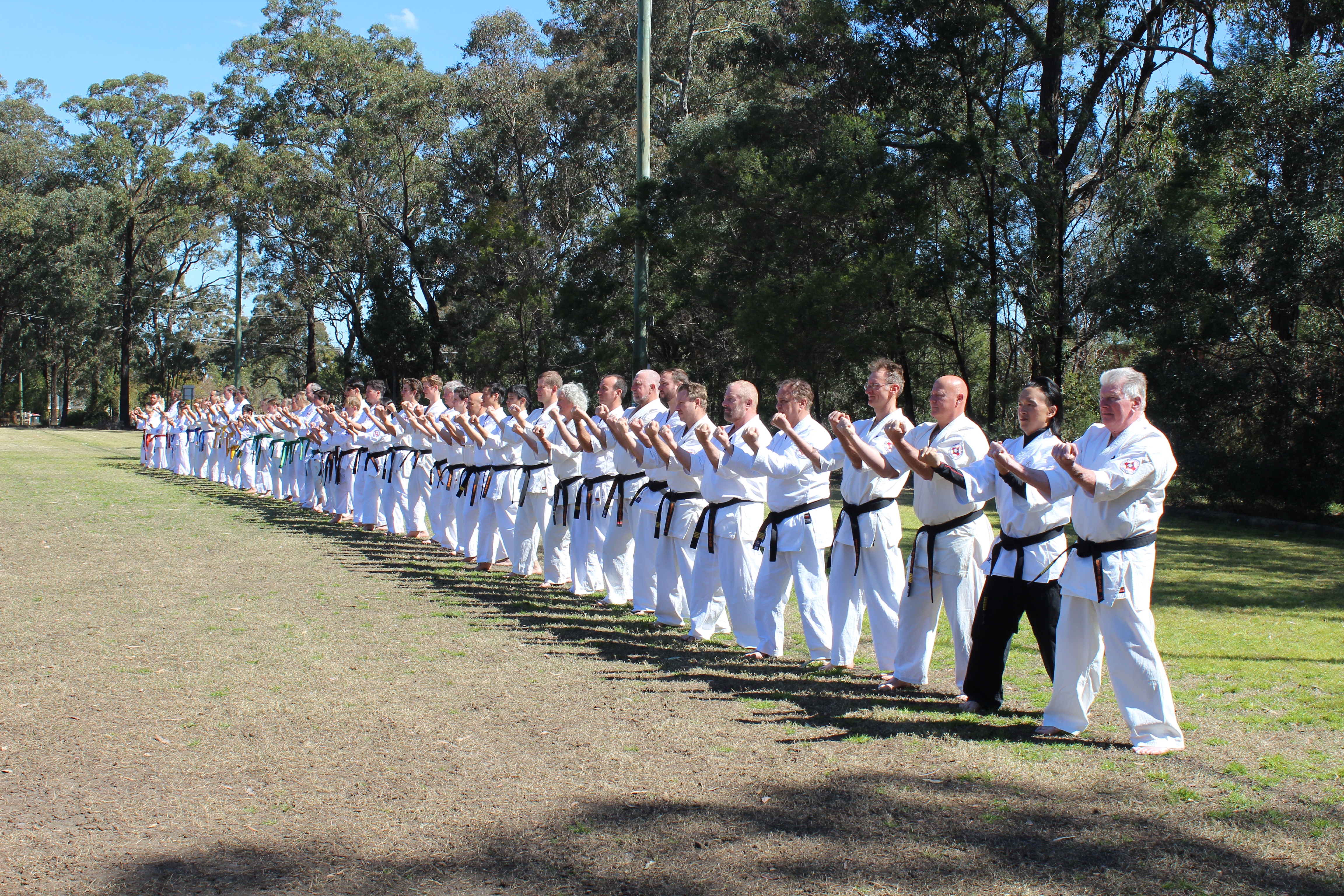
The Saturday morning session.
That afternoon, a class for senior grades and a select couple of juniors was held at Sensei Mark’s Lismore Dojo. Hanshi continued the fighting drills lesson from the morning before Sempai Alex led the group through various kata: Yantsu, Pinan sono Go, Naihanchi and various kata in Ura. A few senior basic techniques were revised before the session finished.
Jermaine Downs, of Brisbane Dojo, at the North Coast KIMAA Seminar.
The Saturday afternoon session.
Sensei Jon and his wife Tabby generously held a group dinner at their home in Ballina.
Sunday featured a three-hour Kyokushin grading for junior adult kyu grades and the Little Lions. Hanshi Howard, Sensei Mark, Sensei Jon and Sensei Rob assessed the students while Sempai Alex led the grading. It was an intense morning, technically focused, fast and entailed a large number of push-ups.
Hanshi was delighted to pass everyone who attempted the grading. Students were awarded their belts that day. Special congratulations go to Blayne and Anthony, who were double-graded to senior yellow belt (5th Kyu). Special mention also must go to 1st kyu Jermaine Downs of North Brisbane Dojo, who exhibited excellent form over the weekend.
The karate class after the grading on Sunday.
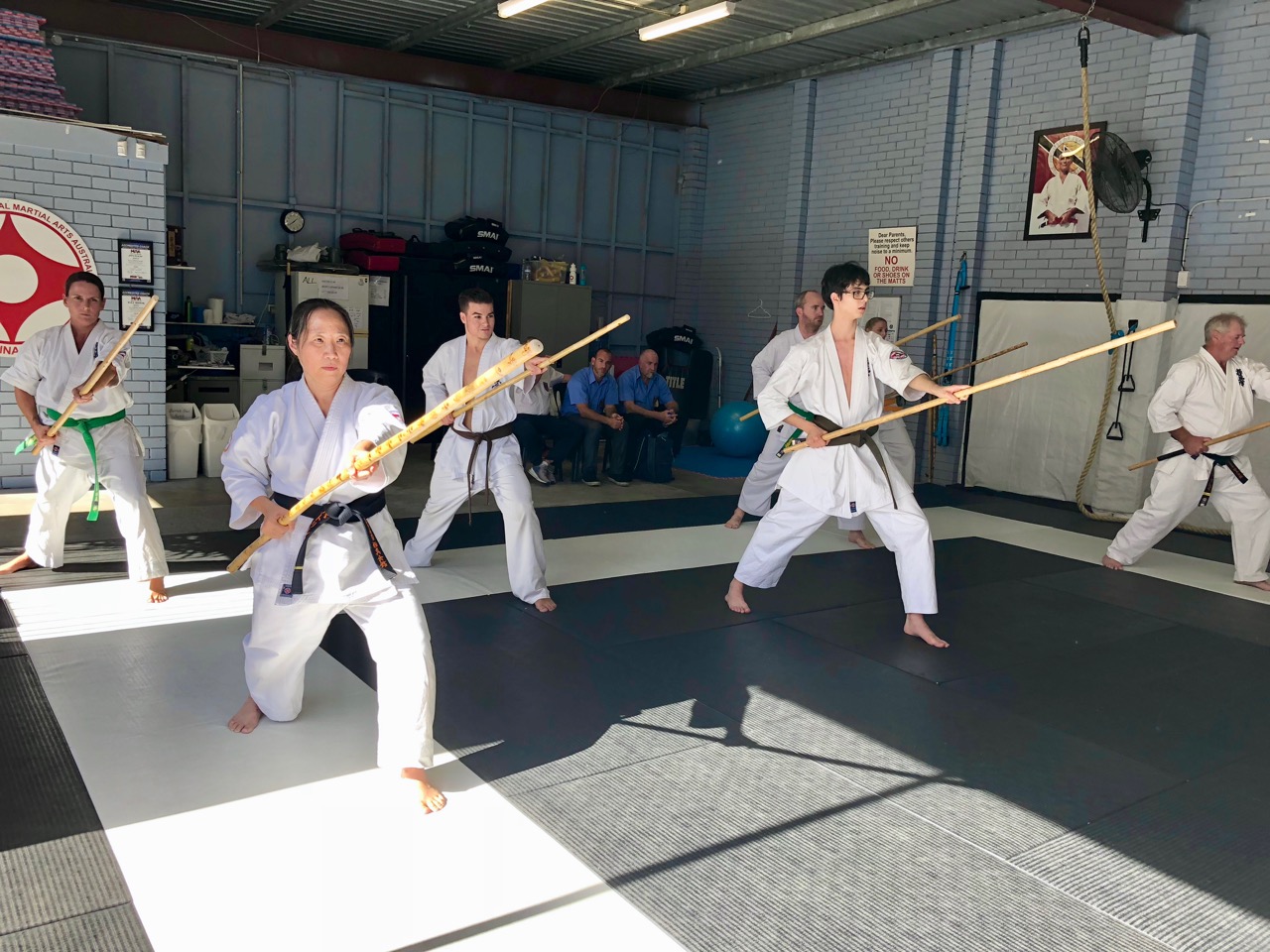
A Kobudo class was conducted after the grading for interested students. Sempai Alex took the group through the finer technical points of the Bo staff, focusing on basic strikes as well as the first exercise and Kihon kata.
Sempai Trish and Wesley lead the Kobudo class.Sensei Jon Ellis and Sensei Mark McFadden during the grading.
It was an outstanding weekend organised by Sensei Jon and Sensei Mark. Thanks go to the North Coast dojo operators for use of their facilities, and to Sempai Wally Gray, Sempai Patricia Tan and Larissa Watson for their assistance as well. The North Coast students who don’t normally get to make the trips to Sydney enjoyed the opportunity to train with the head of the organisation, Hanshi Howard Lipman, which made it a memorable experience for all.
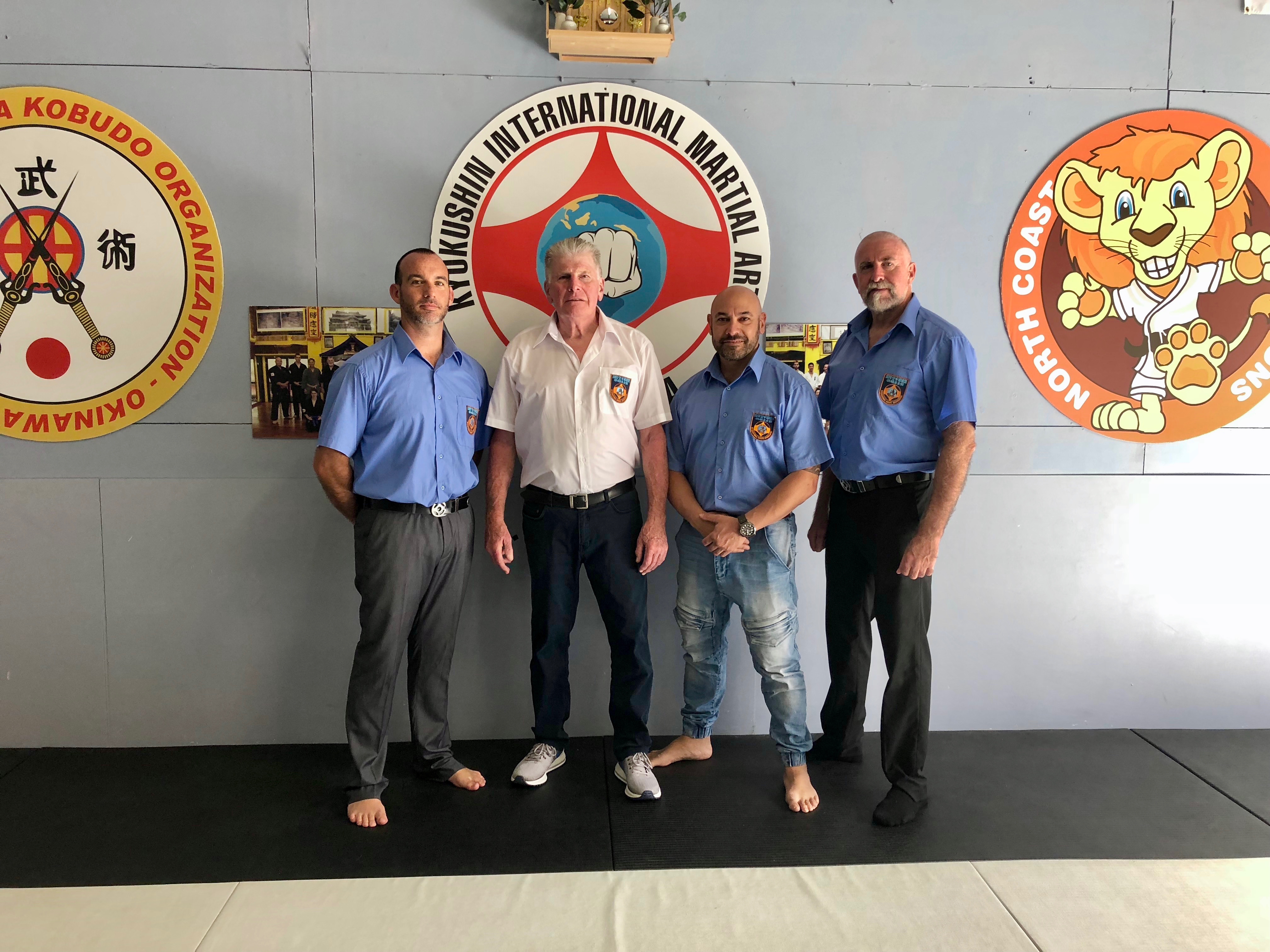
Dojo operators Sensei Jon Ellis, Sensei Rob James and Sensei Mark McFadden with KIMAA Chairman Hanshi Howard Lipman.
The first KIMAA seminar of 2018 was held in Sydney, on the weekend of March 10-11, at Annangrove Dojo.
The focus of the seminar was Kyokushin Karate. Kihon and kata were practised at length, interspersed with fitness and sparring sessions. Tameshiwari (board breaking) and Kobudo (weapons) were also undertaken.
Saturday kicked off with an intense basics session with Shihan Rick Cunningham and Shihan Peter Olive. After everyone was suitably sweaty, the class turned its attention to partner work, Sanbon Kumite, leg blocks and defence, and bunkai from Pinan Ni.
This slideshow requires JavaScript.
After lunch, the seminar broke up into groups. Students not attempting a board break were assigned to a particular group and instructor to revise kata pertinent to their grade level.
For everyone else, Hanshi Howard Lipman led the class through tameshiwari. Hanshi introduced first-timers to the basics of board breaking, while more experienced karateka got some pointers before attempting larger breaks and multi-board combinations.
The class then recombined for an intense bag session, where students rotated through pairings to practise their roundhouse kicks.
Next was the Naihanchi kata. Shihan Idir Bahamid took the seminar through the kata, emphasising the importance of a solid stance and correct focus in the execution of techniques.
This slideshow requires JavaScript.
After studying the kata, the group loosened up for kumite. Kyu grades and the Little Lions had turns sparring the black belts. A few egos were bruised, but everyone enjoyed and learned from the experience.
The seminar group on the Saturday.
That evening, Shihan Rick hosted a dinner for the out-of-Sydney guests and senior grades.
The next morning began with a suitably tiring basics session, led by Hanshi Howard.
After the basics, the seminar spent the rest of the day on self-defence, fighting techniques and kata revision, often broken into smaller groups by grade level. The group also revisited Naihanchi kata. The Kyokushin focus was briefly interrupted for a Kobudo session. Students had the option of learning a Bo, Sai or Eku kata, dependent on their experience level.
Sempai Jason Lambe and Sempai Patricia Tan during the Sydney KIMAA Seminar.
Shihan Peter Olive instructing.
The class finished up after a final group session. The KIMAA seminars continue to be an important feature on the calendar for students to interact with members from other parts of the organisation, and for the instructors to ensure unity in technical standards and Kyokushin spirit. Thanks go to all the organisers, and those who made the effort to travel to Sydney.
The next KIMAA seminar is at the North Coast in May.
The weekend of 10-11 February saw two senior classes take place in Sydney.
Hanshi Howard Lipman led a Black Belt class at Turramurra Dojo on the Saturday afternoon. Assisting with instruction were Shihan Peter Olive and Shihan Idir Bahamid. Some basic blocks, strikes and kicks were covered, along with most senior kata. The class finished with some partner drills.
Shihan Peter Olive and Shihan Idir Bahamid
Sensei Paul Finnerty, Sensei Mark Shelmerdine and Sensei James Sidwell
Hanshi Howard Lipman and Sensei Ben Ng
It was a hot, sweaty afternoon of Kyokushin training, but everyone pushed themselves hard. Yudansha of Turramurra and Annangrove dojos trained, along with Sensei David Craigie of Young Dojo.
Sensei James Sidwell, Sensei Don Cheong, Stephen Runge, Sensei Ben Ng, Sempai Jason Lambe, Hanshi Howard Lipman, Sensei David Craigie, Bernard Wilson, Sensei Ian Holdaway, Sempai Josh Darley, Sensei Paul Finnerty, Sensei Mark Shelmerdine, Shihan Peter Olive, Shihan Idir Bahamid and Sempai Alex Lloyd.
Both classes are gearing towards the March KIMAA Seminar in Sydney, and the next senior grading in June. Keep up to date with KIMAA events in the calendar.
Another enjoyable and successful year has passed for Kyokushin International Martial Arts Australia. The year saw the expansion of the organisation, further refinement of technical ability and entry in various competitions.
A good portion of the trip was spent sightseeing in Tokyo, Yudanaka, Nagano and Kyoto, before heading to Okinawa. One of the destinations was the shrine to Sosai Mas Oyama at Mt Mitsumine, as well as his actual grave.
This slideshow requires JavaScript.
Tony Kuo of Turramurra Dojo joined the group in Okinawa. The first highlight in Okinawa was training with Sensei Tetsuhiro Hokama and Shihan Ken Ogura in Karate and Kobudo weapons. Sensei Hokama also graded Sensei Jon to 3rd Dan in Kobudo, and Sempai Alex to 2nd Dan.
Sensei Jon Ellis, 3rd Dan Kobudo
Sempai Alex Lloyd, 2nd Dan Kobudo
Sensei Tetsuhiro Hokama
Shihan Howard Lipman
Shihan Ken Ogura
KIMAA with Sensei Hokama and Shihan Ken after training.
The final event of the tour was the Kyokushin Union’s 4th World Tournament, a two-day event featuring Kyokushin fighters from a large range of countries. The trip was a memorable and enjoyable experience.
KIMAA at the Kyokushin World Tournament.
SYDNEY, NSW
The Sydney dojos were home to a variety of KIMAA events in 2017, from junior and senior gradings and a major seminar. The year began for some Sydney instructors with the Japan trip, including the World Tournament.
These competitive efforts were followed quickly by Turramurra and Annangrove Dojo members competing in the AKKA New South Wales State Championships in June, hosted by Hanshi John Taylor. A large group competed, led by senior grade Sensei Ben Ng. Special mention goes to Elia Parsanejad, Eric Wright and Sempai Josh Darley for their placements.
Annangrove Dojo continued its fitness program over the course of the year. Shihan Rick Cunningham and Sensei Paul Finnerty teach fitness classes on Tuesdays and Thursdays, in addition to the Karate classes on other weeknights and weapons on Sundays. Not all participants in the fitness classes train in karate, many coming along just to improve their wellbeing and cardio ability. The group has grown steadily.
The focus moved from competitive fighting to the wider level of training needed for a grading, in preparation for the Senior Kyokushin Grading in August. Participants included members from Turramurra and Annangrove, as well as karateka travelling down from the North Coast dojos. Hanshi Howard assessed students while the grading was led by Shihan Rick and Shihan Peter Olive.
This slideshow requires JavaScript.
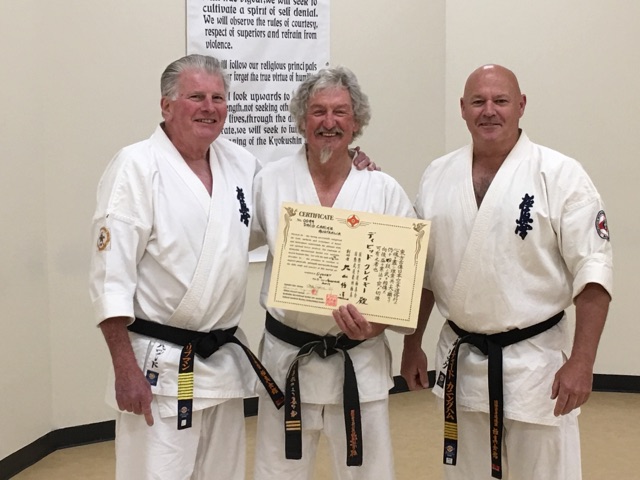
The day produced KIMAA’s newest black belt, Sempai Will Brook, of Ballina Dojo.
Sempai Will Brook, Hanshi Howard Lipman & Sensei Jon Ellis
At the conclusion of the grading, Shihan Rick announced a special surprise for the Chairman of KIMAA. The KIMAA Grading Committee – consisting of Shihan Rick, Shihan Peter, Shihan Idir Bahamid and Sensei Mark McFadden – promoted Howard Lipman to the rank of 9th Dan and the title of Hanshi in Kyokushin Karate.
The KIMAA grading committee with Hanshi Howard Lipman. From left: Sensei Mark McFadden, Shihan Rick Cunningham, Hanshi Howard Lipman, Sensei Idir Bahamid & Shihan Peter Olive.
Following the success of the 2016 Shihan Ken seminar, Shihan Ken was warmly invited back to instruct in the KIMAA Shihan Ken Seminar of 2017. The seminar ran over three weeknights and a full weekend in September at Turramurra and Annangrove. Members from all KIMAA dojos participated, as well as Shihan Doug Turnbull of KIKO on one night, and guest members from Sensei David Craigie’s Kyokushin dojo in Young across most of the week.
The week focused heavily on bunkai (self-defence applications from kata), as well as conditioning, miscellaneous self-defence, technical training and weapons. All students look forward to future training with Shihan Ken.
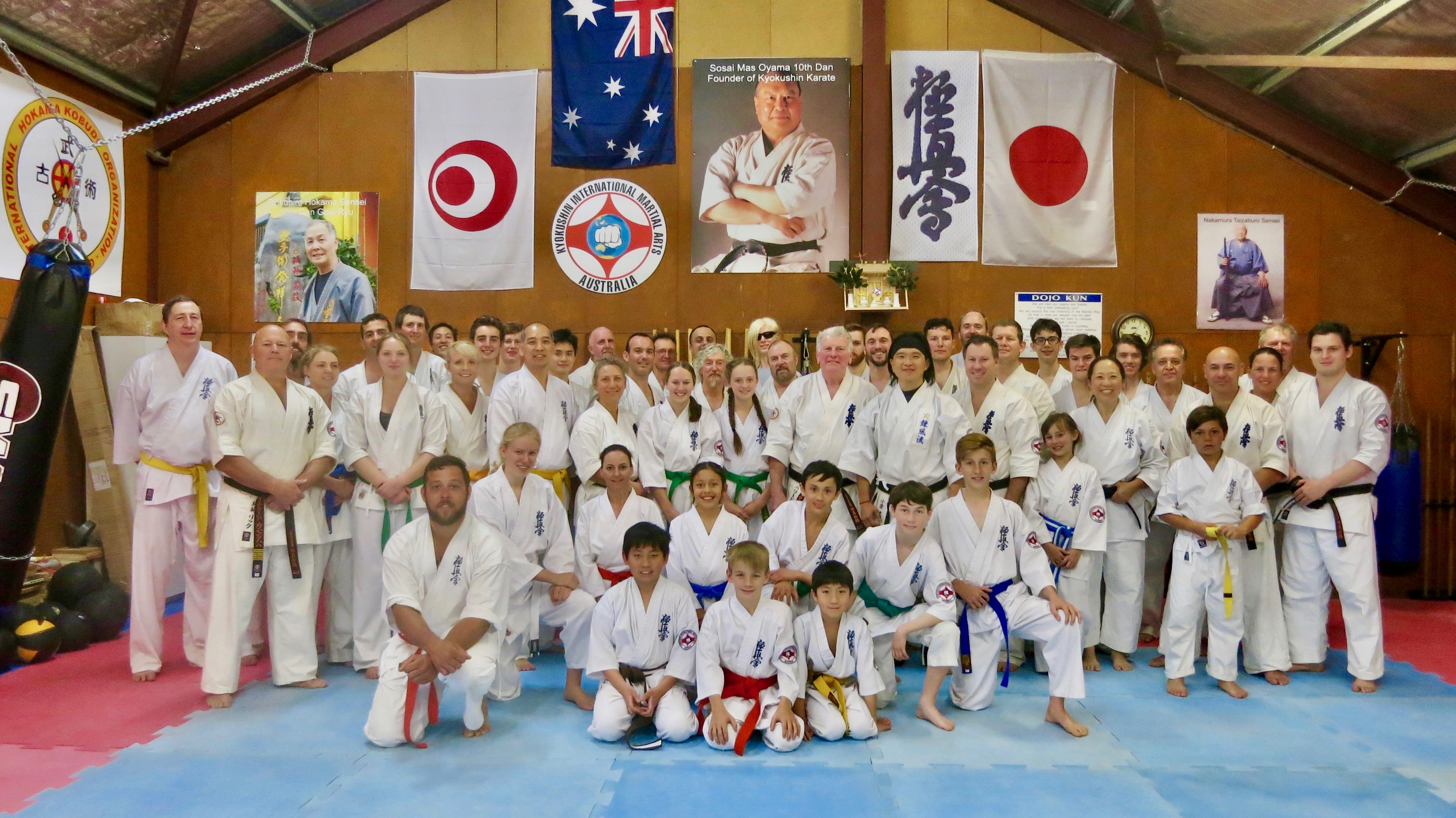
KIMAA at the Shihan Ken Seminar, September 2017
One of Sydney’s senior instructors was promoted during the seminar – Idir Bahamid was awarded by Hanshi Howard his 5th Dan in Kyokushin and the title of “Shihan”. Shihan Idir is already a 5h Dan in Shotokan Karate.
Hanshi Howard Lipman & Shihan Idir Bahamid
Kobudo training continued throughout the year at Annangrove Dojo. The senior group focused in particular on new katas taught to them by Shihan Ken.
Final Sydney Kobudo training of 2017. From left: Sensei James Sidwell, Shihan Rick Cunningham, Sempai Jessica Den, Shihan Peter Olive, Sensei Paul Finnerty, Sempai James Campbell, Sensei Mark Shelmerdine & Sempai Alex Lloyd.
The start of the year also unveiled an ongoing series on this website, “From the Archive”. Hanshi Howard dug up his wealth of Kyokushin photos, documenting his training from white belt to training with Sosai Mas Oyama to the present day. After a lot of scanning by Sempai Alex, a new batch was posted to the website every month. The publishing program finished with the year 2010, posted this December:
Sensei Elaine Kwok, Hanshi Howard Lipman, Sosai Mas Oyama, Shihan Rick Cunningham, Sensei Carl Syddall and Sensei Adrian Layton, Branch Chief Camp in Japan, 1993.
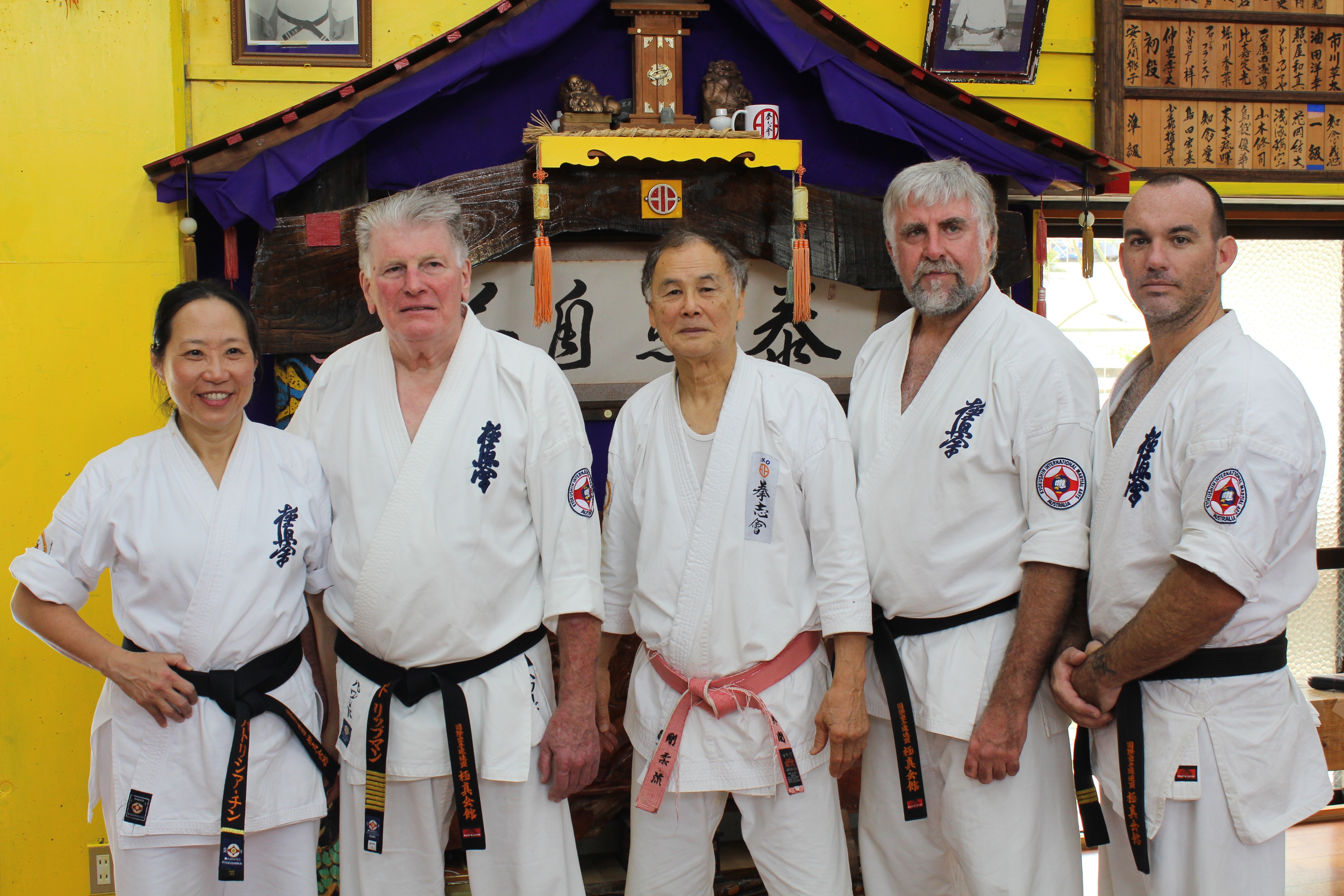
Sempai Trish, Hanshi Howard, Sensei Hokama, Sensei Mark & Sensei Jon in Okinawa, Japan, January 2017.
March saw the first 2017 KIMAA seminar hosted at the North Coast dojos, conducted by Hanshi Howard Liman. Members from Lismore and Ballina participated, as well as some students under Sensei Rob James of his two dojos.
The Sunday adults class at Lismore Dojo.
The seminar was a terrific weekend held at Ballina and Lismore across the two days, focusing on basics, fitness, kata, kumite and the finer points of stance and technique across the Little Lions, adults and senior grades.
Sempai Rob James, Sempai Alex Lloyd, Shihan Howard Lipman, Sensei Jon Ellis & Sensei Mark McFadden.
The North Coast students continued their hard training, entering a number of competitions over the course of the year. This includes the Little Lions’ efforts in May, and young Isaac’s in October.
Lismore Dojo at the NAS
The North Coast enjoyed reminding the rest of KIMAA that Karate doesn’t always have to mean indoor training! Sensei Mark held a grading for Lismore Dojo in June, which students of Ballina also attended, at Evans Head beach. The class enjoyed the sunny teachings of Sensei Mark, Sensei Jon, Sempai Wally Gray and Sempai Trish.
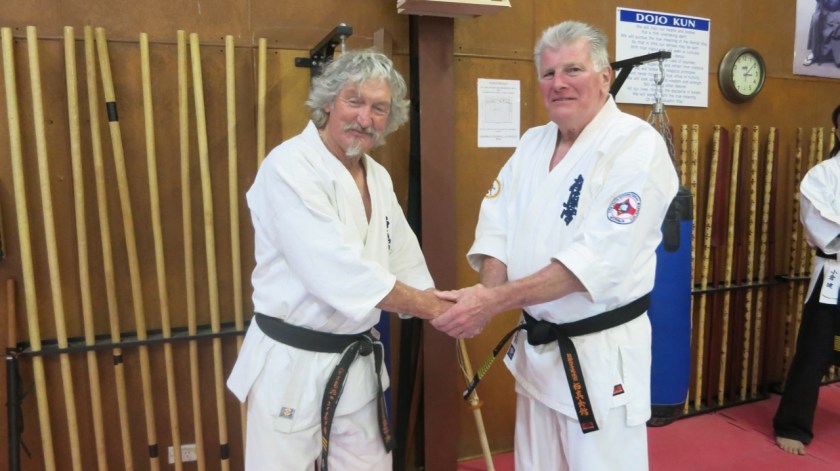
Hanshi Howard Lipman with Sensei Rob James, Lismore Dojo.
Later that month, North Brisbane’s Little Lions entered one of the National All Styles tournaments. Young Sean gained a placement, and all entrants were participating in their first tournament. Sean continued his efforts at the NAS in October.
Sensei Rob with some of his Little Lions at a tournament
The Queensland KIMAA students are a bit further way from the central action of KIMAA geographically, but they don’t let that stop them keep driving harder and harder to pursue greater martial arts skills. This was typified by the efforts in the June gradings.
This slideshow requires JavaScript.
Sensei Rob represented Queensland at the Shihan Ken seminar in September. Like all seniors who participated, he honed his technique and took away insightful lessons of Karate’s hidden secrets. He was also greatly surprised when Hanshi Howard promoted him to the rank of 3rd Dan and title of Sensei.
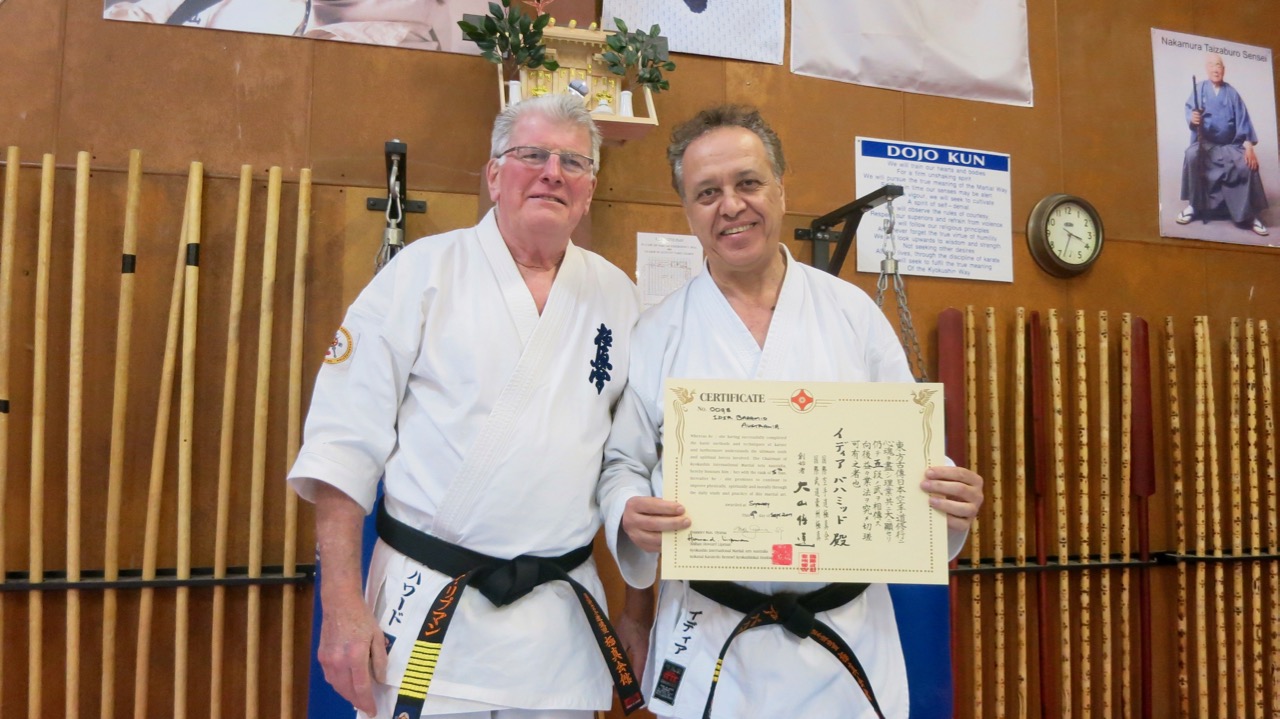
Hanshi Howard Lipman & Sensei Rob James
YOUNG, NSW
Sensei David Craigie commenced his Kyokushin training in 1971, obtaining Shodan in 1976. He has also been teaching since the 1970s.
During the KIMAA Shihan Ken Seminar in September 2017, Sensei David was invited to attend and bring some of his students. Over the course of the seminar, Sensei David was greatly impressed by the quality of people and martial arts skills at KIMAA. He enthusiastically accepted when invited to join by Hanshi Howard Lipman.
Young Dojo with Hanshi Howard & Shihan Rick
On September 10, Sensei David and his dojo formally joined KIMAA, and was welcomed by all. Sensei David is the dojo operator of KIMAA’s seventh dojo.
While a newcomer to KIMAA, Sensei David has been teaching Kyokushin for over forty years. Hanshi Howard graded Sensei David to 4th Dan in recognition of his decades teaching Kyokushin.
Hanshi Howard Lipman, Sensei David Craigie & Shihan Rick Cunningham
The final training session of the year featured a guest appearance from Sensei Don Cheong, of Turramurra Dojo, and Sempai Mark Long, an old student of Hanshi Howard.
This slideshow requires JavaScript.
CLOSING
This year saw KIMAA continue its efforts internally and externally, through seminars and gradings to Japan trips and tournaments, pushing its students and seniors to improve their Karate in every aspect. Strong and experienced leadership has seen the KIMAA students continually exposed to new opportunities, especially spending time with other great senior martial artists.
Warm thanks go to the dojo operators and other instructors for keeping the organisation running smoothly, especially Hanshi Howard, Shihan Rick, Shihan Peter, Sensei Mark, Sensei David, Sensei Jon and Sensei Rob.
Your instructor will advise you of holiday closure dates, or any combined classes and holiday training. Merry Christmas and Happy New Year to all, and see you in 2018. Osu!
Kyokushin International Martial Arts Australia, September 2017
The seminar brought KIMAA students from all over the organisation. Guests from other Kyokushin dojos also attended, including Sensei David Craigie and his Young Dojo.
Wednesday night’s training was held at Turramurra Dojo. Shihan Ken took students through bunkai – the self-defence application of techniques and moves from kata. The kata focused on in particular were more of a junior level, to teach the foundation principles required for the weekend. Shihan Peter Olive dutifully resumed his duties from the previous year’s seminar, serving as the ‘crash test dummy’ that Shihan Ken would demonstrate the techniques, pressure points and take-downs on!
Shihan Rick Cunningham, Shihan Ken Ogura, Sensei Paul Finnerty and Sempai Alex Lloyd, 7 September 2017.Shihan Doug Turnbull training with Sensei Mark McFadden.
Training continued along the same lines as Wednesday, but with some more advanced techniques and kata.
Shihan Rick Cunningham, Shihan Doug Turnbull, Shihan Peter Olive, Shihan Ken Ogura & Hanshi Howard Lipman.
After training, a group dinner was enjoyed at Noodle City in Gordon.
The Friday night class.
The seminar continued at 9 am sharp on Saturday 9th at Annangrove Dojo. Hanshi Howard formally introduced Shihan Ken to all the black belts, then led the group through a basics session.
This slideshow requires JavaScript.
The students were then broken up into smaller groups for rotating classes that lasted throughout the day. One group would be inside with Shihan Ken, while the others trained outside. Shihan Ken took the seniors through a new Eeku kata, and other groups through further bunkai and kata work. The others rotated between kata with Shihan Peter Olive, technique and focus with Sensei Idir Bahamid, the Sai with Sensei Mark Shelmerdine and the Bo staff with Sempai Alex Lloyd.
Sensei Ian Holdaway on the BBQ
The KIMAA NSW Far North Coast crew with Shihan Ken Ogura.
At the end of a long but enjoyable day, Hanshi Howard Lipman announced a few Kyu grade promotions in Kobudo, and three black belt promotions in Kyokushin. Read more here about the promotions of Shihan Idir Bahamid, Sensei Mark McFadden and Sensei Rob James.
This slideshow requires JavaScript.
Dinner for the out-of-Sydney guests and other seniors was held at Shihan Rick’s home. Thanks go to Shihan Rick Cunningham and his wife Kirsti for hosting Saturday’s dinner, and to Sensei Ian Holdaway for his lunch barbecuing efforts on both weekend days.
Group photo of the Saturday seminar class.Sensei Don Cheong demonstrates Pinan Sono Go.
Training began early the next morning back at Annangrove Dojo. The day began with a session focusing on basics, movement, speed and power with Shihan Idir Bahamid. After this, the seminar split into smaller groups, with Shihan Peter Olive, Sensei Paul Finnerty, Sensei James Sidwell and Sensei Mark McFadden taking instructional duties for those not working with Shihan Ken. The black belts had intense kata sessions on both Saturday and Sunday with Shihan Peter, including kata demonstrations by Sensei Don Cheong.
Shihan Ken continued the same focus with the Kyu grades, while working with the black belts further on the Eeku kata, as well as Seipai and Saiha. Sensei Jon Ellis and Sensei Ben Ng took turns being the test dummies during the day.
The day ended with Hanshi Howard thanking those from out of Sydney for travelling, Shihan Rick for all his help with the organising and accommodation, and most of all Shihan Ken for coming to Australia again to instruct KIMAA students.
Hanshi Howard Lipman ended the day with some exciting news. After several days of intense training together, the students of KIMAA built a great rapport of those with Young Dojo, and Sensei David Craigie (3rd Dan) had a great time training with KIMAA’s black belts. It was announced on Sunday September 10 that Sensei David Craigie and Young Dojo are now a part of Kyokushin International Martial Arts Australia, the seventh dojo of the organisation.
Sensei David & Hanshi Howard
Sensei David & Hanshi Howard
Young Dojo with Hanshi Howard & Shihan Rick
The final training session was back at Turramurra Dojo on the Monday night. This evening was spent consolidating the week’s worth of knowledge, with Sensei Ben acting as Shihan Ken’s demonstration partner for the evening. There was also a greater focus on pressure points and conditioning.
KIMAA is delighted to have an ongoing relationship with Shihan Ken Ogura, such a widely regarded martial artist who is also an excellent teacher and friend of the organisation. We look forward to future training with Shihan Ken.
Hanshi Howard Lipman, Shihan Idir Bahamid, Sensei Mark McFadden, Sensei Rob James and Shihan Rick Cunningham, 9 September 2017.
Congratulations to Shihan Idir, Sensei Mark and Sensei Rob on their new grades, and their decades of devotion to martial arts and KIMAA.
Shihan Idir Bahamid
Shihan Idir Bahamid is 5th Dan in Kyokushin Karate, 5th Dan in Shotokan Karate and 1st Dan in Kobudo. He commenced his karate training in 1966. He trained in the style of Shotokan in Europe and North Africa with Sensei Taiji Kase, Sensei Hiroshi Shirai and Sensei Keinosuke Enoeda. He obtained his 1st Dan in Shotokan in 1971 and was graded to the rank of 5th Dan by Sensei Kasein 1988 at an international training camp in Paris.
Between 1977 and 1982, Shihan Idir was instrumental in the promotion and development of Karate in Romania. He established Dojos in different cities and conducted regular training camps. After moving to Australia in 1988, he continued his karate training in Shotokan in a number of Dojos across Sydney before beginning his training in Kyokushin Karate with Hanshi Howard Lipman in 2004 at the Turramurra Dojo. He was graded to 4th Dan in Kyokushin by Hanshi Howard in 2010 and to 5th Dan in Kyokushin in 2017.
Click here to see a photo gallery of Sensei Idir training in his youth, demonstrating the power of Karate.
Sensei Mark McFadden
Sensei Mark McFadden is 4th Dan in Kyokushin Karate and 3rd Dan in Kobudo. He commenced his Karate training in 1980. He participated in local, state and national tournaments from 1982 to 1990, gaining places at the local and state levels. He began teaching Karate in the mid 1980s.
After competing in the Australian Championships in 1990, Sensei Mark took time out to further his education, career and family. He returned to training in 1996, opening a dojo at the Fraternity Club in Fairy Meadow NSW, and graded to 1st Dan in March 2000.
After relocating to the North Coast Sensei Mark opened Lismore Dojo in 2006, and in 2008 opened Ballina Dojo. Sensei Mark regularly travels to Sydney for black belt training with other KIMAA senior grades. He has gone to Japan four times for training in 2008, 2013, 2015 and 2017.
Sensei Mark was promoted to 3rd Dan by Hanshi Howard Lipman in 2013 and to 4th Dan in 2017.
Sensei rob james
Sensei Rob James is 3rd Dan in Kyokushin Karate. Sensei Rob began his Martial Arts training in the late 80s in AFTA Freestyle Tae Kwon Do. Karate, being new to his home town of Inverell, soon took Sensei Rob’s interest and in time progressed to the rank of 1st Dan.
After opening a Dojo in 1992, Sensei Rob contacted Hanshi Howard Lipman in Sydney and after lengthy discussions as to what would be expected of him, joined the International Karate Organisation Kyokushinkaikan.
Sensei Rob, who holds Dan grades in both Shotokan and Kyokushin Karate, began teaching self defence to schools, nurses, police and community groups. Over the years Sensei Rob also studied Boxing as well as Seiyushin Karate under Sensei Nagayama, a former Kyokushin Uchi Deshi under Sosai Mas Oyama. He opened Aspley Dojo in 2012 and joined KIMAA, once again working with Hanshi Howard Lipman to spread the teachings of Kyokushin.
Sensei Rob was graded to 2nd Dan in 2014 by Hanshi Howard Lipman. In 2016, Aspley Dojo became North Brisbane Dojo. In the same year, Sensei Rob opened KIMAA’s sixth dojo, Nundah Dojo. He was graded to 3rd Dan (Sensei) in 2017 by Hanshi Howard Lipman.
Hanshi Howard Lipman, Shihan Idir Bahamid, Sensei Mark McFadden, Sensei Rob James and Shihan Rick Cunningham.
























 Kyokushin International Martial Arts Australia