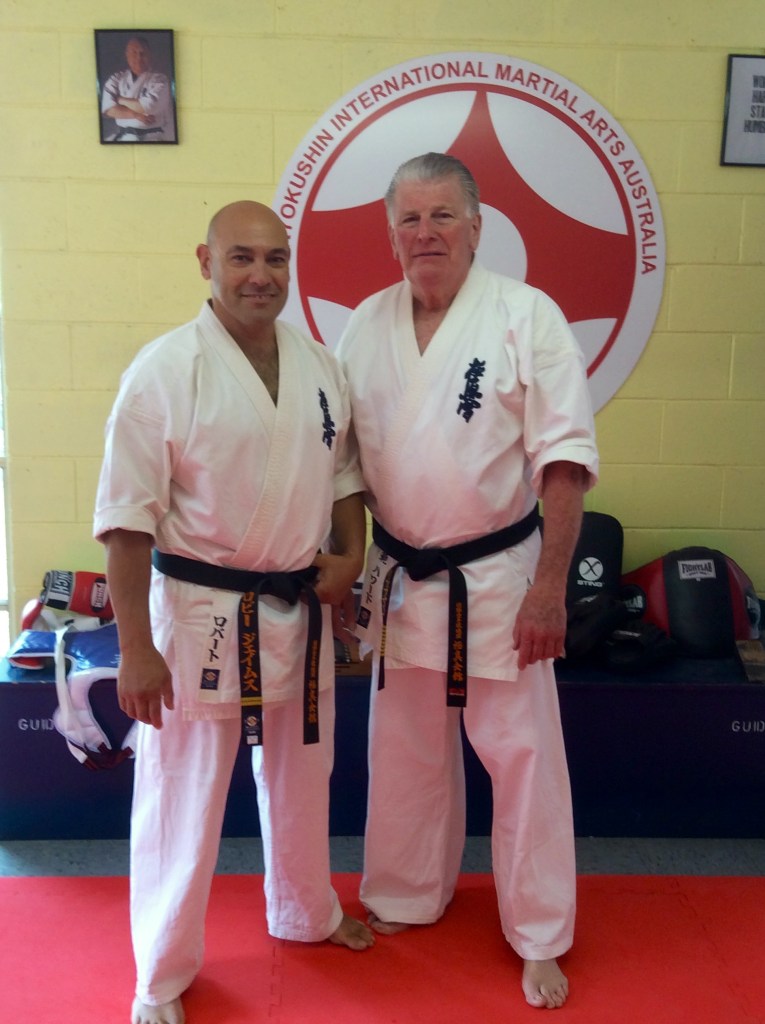
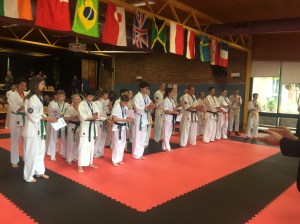
On the weekend of November 28-29, my wife Masumi and I travelled to Brisbane for me to conduct a seminar at Sempai Rob James’s (2nd Dan Kyokushin) dojo in Aspley. There were 15 kids and 12 adults in attendance over the course of the weekend.
Sempai Rob and Shihan Lipman lead the class.
Aspley Dojo Little Lions with Shihan Lipman.
On Saturday afternoon the first class was for the kids who were initially a little apprehensive, however they were soon made to feel at ease and settled down to enjoy their class. I was most impressed with their level of knowledge and attitude towards training. The class consisted of Kihon, Ido Geiko and Kata.
Personalised belts
At the conclusion of the class, Masumi wrote all the kids’ names on their belts in Japanese, which they thought was great.
This class was followed by a session with the adults where once again I checked and emphasised the importance of basics. Most of the class was spent on Kihon and Ido Geiko. Both were at a good standard, which is always a measure of capable students and a quality and dedicated instructor.
On Sunday morning there was another class for the adults and this was orientated towards Ido Geiko, Kata, some fighting techniques and a little self-defence. All the adults performed well and have potential to move forward in their grades.
A few deserve special mention: Jermaine and Amanda, the senior kyu grades, are excellent role models for the more juniors. Chris and Yolanda from the junior kyu grades also performed exceptionally well.
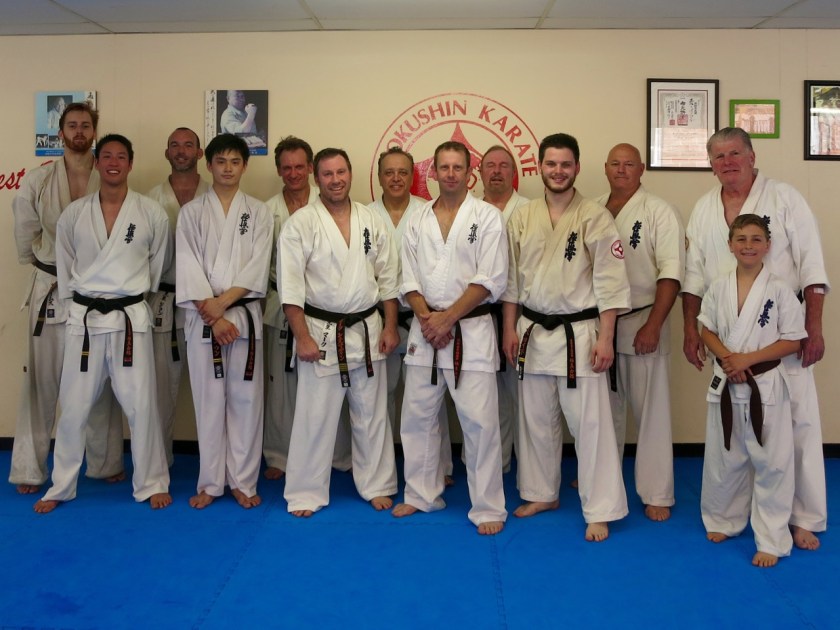
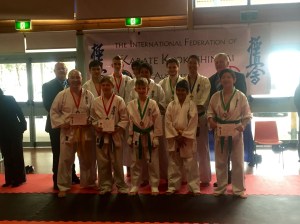
Aspley Dojo adults with Shihan Lipman.
All the adults also had their names put on their belts in Japanese by Masumi.
The seminar was a great success and enjoyed by all. Congratulations are due to Sempai Rob, who I have known since he was 17 years old. It has been interesting and pleasing to watch his progress over the years. His dojo now is well organised and well disciplined which is a mark of the man himself.
Although often taken for granted, our eyes guide us throughout our lives. From when we wake up in the morning, to the moment we fall asleep, we look, we see, and we do. The importance of our eyes and the sense of sight extends to karate, and the karateka (karate student) must train them well. Visual focus is the foundation of posture and balance. It provides a frame of reference and is critical to both focus and general alertness. The karateka must never forget their eyes in training, in particular kihon (basics), ido geiko (moving through in stance), kata (formalised pattern or form) and kumite (sparring).
1. Kihon
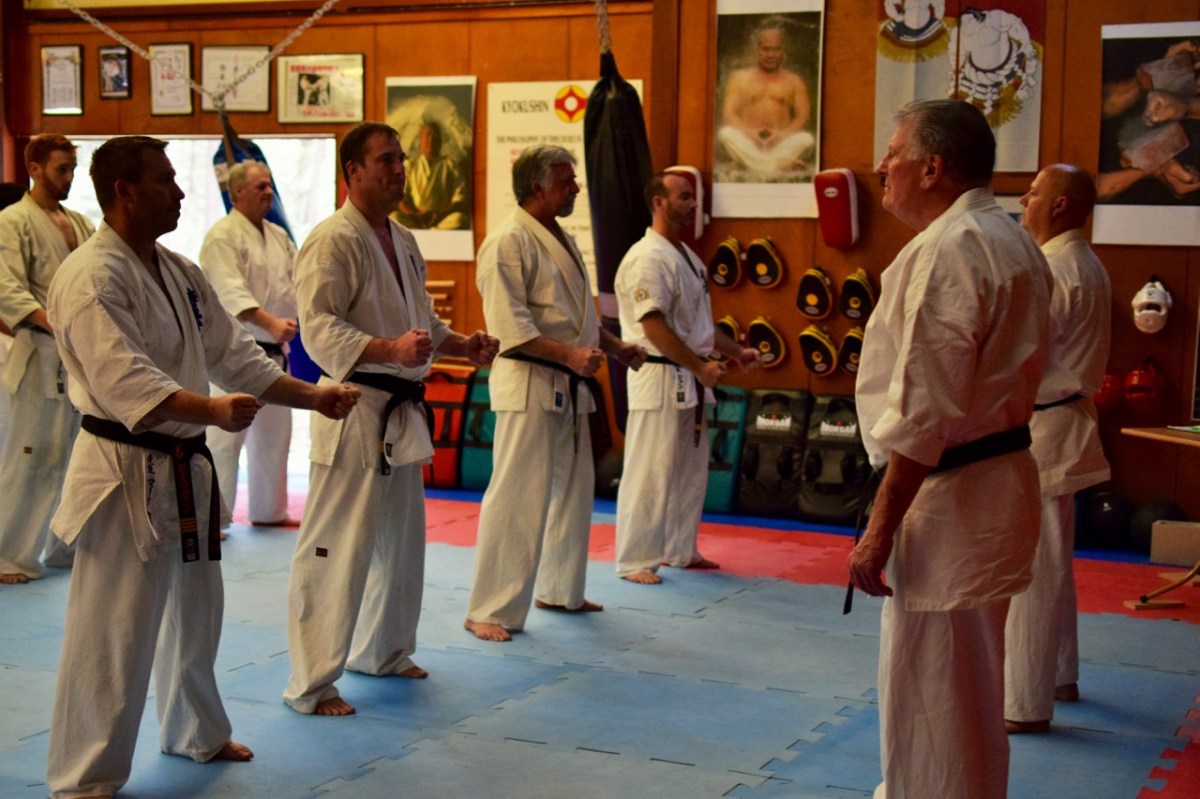
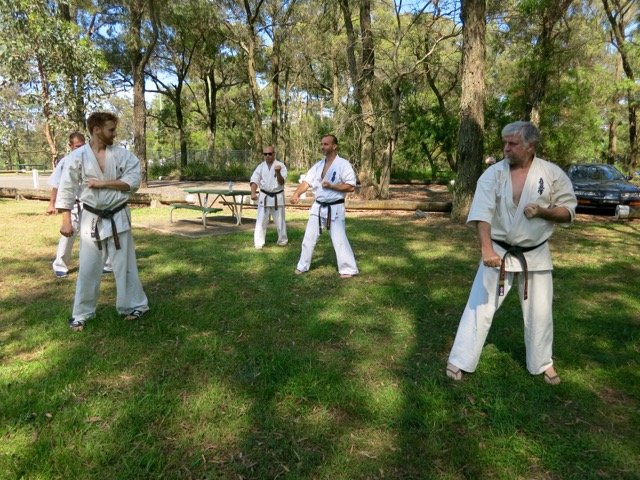
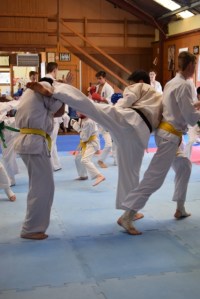
Jermaine demonstrates excellent visual focus while practising kihon.
When one begins training in karate, they begin with basic training, known as ‘kihon’. The white belt is instructed on posture and balance as a foundation of their training. While developing posture and balance, the karateka must focus their eyes correctly. In kihon, the karateka must look ahead at eye level, and not down at the ground. Looking ahead ensures the body is upright, chin held high and back straight. This helps open the chest for breathing, allows for proper tensing of the core and ensures that energy is flowing freely from the ‘hara’ (reservoir of energy located below the navel). If the karateka is to look at the ground, their posture and balance will be poor, their breathing hindered and internal energy flow restricted. The eyes must therefore be trained well in kihon.
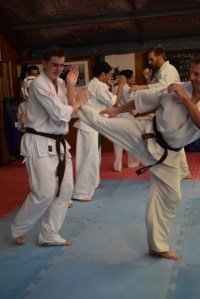
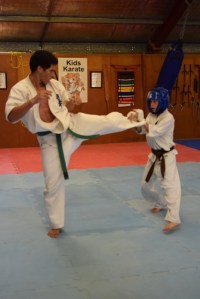
Some more advanced kihon involve circular techniques, such as ‘mawashi geri’ (roundhouse kicks) and ‘ushiro mawashi geri’ (reverse roundhouse kicks). With the added movement in these techniques, positioning of the eyes is even more crucial in maintaining posture and balance. The eyes must look forward at all times. With spinning kicks, the eyes lead the execution. The head turns first to enable the eyes to lock on to the imaginary opponent in front of them, which establishes a frame of reference for the body and leg to follow for the remainder of the kick. Without this focus (‘kime’), the technique will lack balance, and without this kime, the body has no frame of reference from which to execute techniques. The mastery of advanced karate techniques is difficult to achieve without training of the eyes.
2. Ido geiko
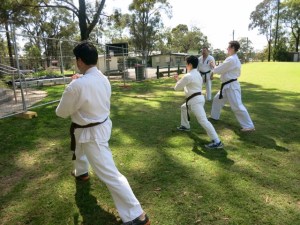
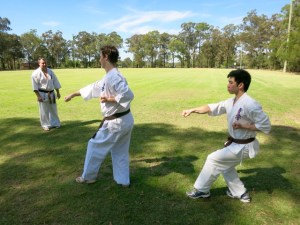
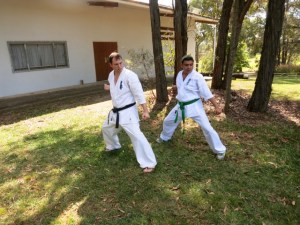
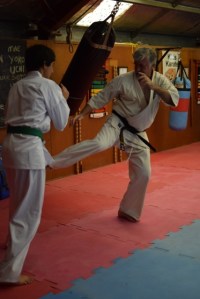
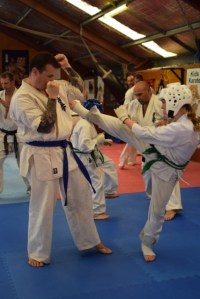
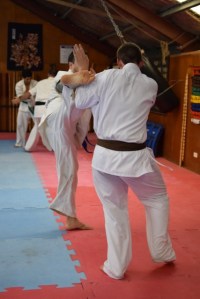
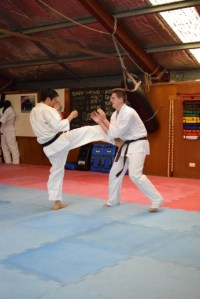
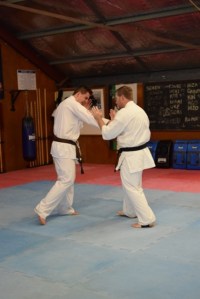
Victor and Josh use their eyes for ido geiko.
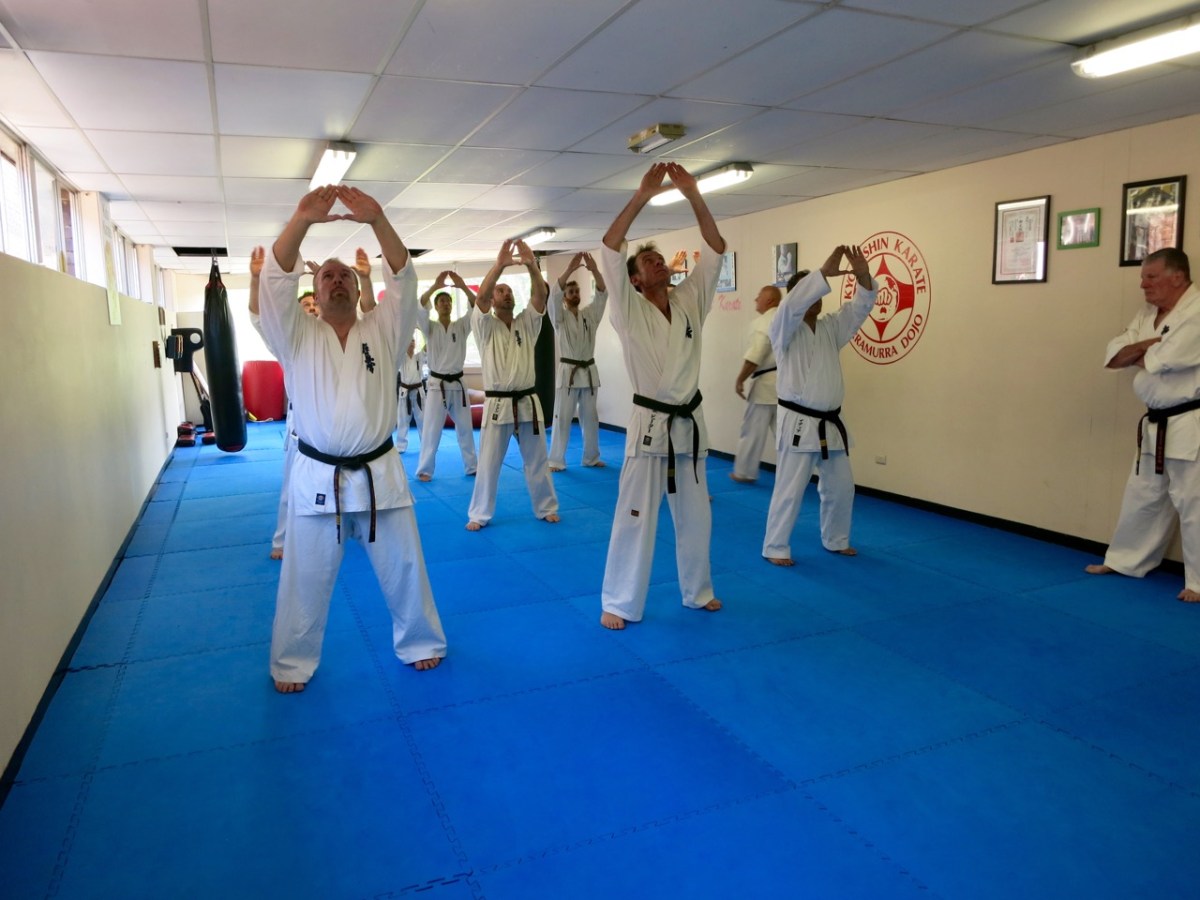
The next stage of karate training involves moving through in different stances and executing various techniques, otherwise known as ‘ido geiko’. The eyes again play a vital role. Ido geiko involves moving up and down the dojo, always with a turn or ‘mawatte’ at each end. The head and eyes must lead the turn for balance and in particular, for the karateka to see the imaginary opponent behind them before turning. More advanced ido geiko training involves moving in ‘kaiten’ and ‘sagari’ (‘turning around’ and ‘turning retreat’). It is critical, as with the mawashi techniques, that the eyes lead the turn and lock onto the front position before the remainder of the turning around or turning retreat is executed. The eyes must therefore be trained well in ido geiko.
3. Kata
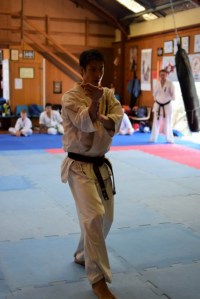
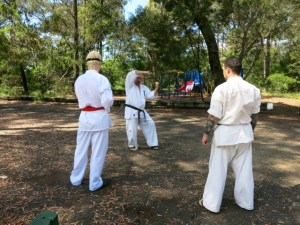
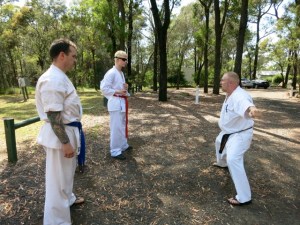
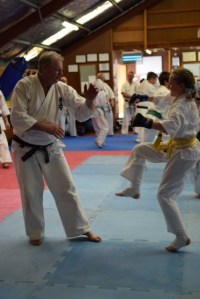
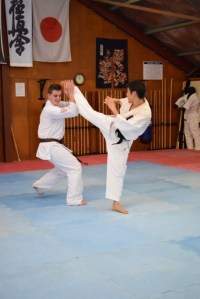
Sensei Don shows how using the eyes is essential for balance and correct technique in kata.
In karate, one of the key training foundations is ‘kata’. Kata combines posture, balance and technique in a formal pre-arranged pattern. As the eyes improve proficiency in these three aspects, as discussed above, kata also requires correct visual focus. Karateka are always taught to ‘look first’ when they begin their kata. While this teaching is usually explained by the importance of seeing one’s opponent, ‘looking first’ is also critical in ensuring the eyes are focused on a position, establishing a frame of reference and enabling the rest of the body to follow, so the technique is executed with balance. This is even more important with kata performed in ‘ura’ (spinning around). Leading the kata with the eyes also creates intention in the movements, making the direction of the movements clear and forecasted. The eyes must be trained well in kata.
4. Kumite
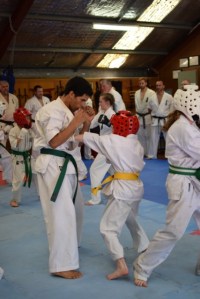
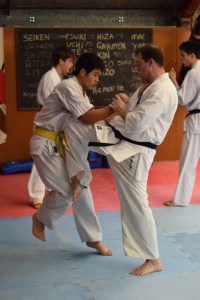
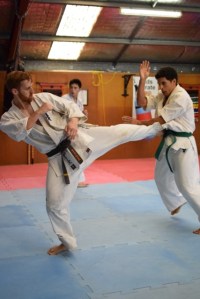
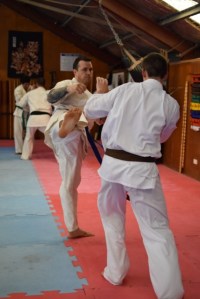
Sensei Don uses his visual focus to land a blow in kumite.
One of the physical ultimates of karate is ‘jiyu kumite’ (free sparring). The eyes are critical in kumite to ensure the whole of the opponent is visualised. There is some debate about exactly where the eyes should look, however focusing on the region between the chest and the opponent’s eyes is generally accepted. Focusing on this area allows the karateka to see, in their peripheral vision, the whole of the opponent. This general alertness or remaining spirit is known as ‘zanshin’. The correct visual focus and zanshin allows for instantaneous detection of any body movement by the opponent, whether it is the initial stages of a kick, a punch or a flinch that may signal the initiation of a technique. Conversely, focusing the eyes on an opponent’s hands or legs will result in a failure to detect movement in other parts of their body, therefore creating blind spots. Correct visualisation with the eyes is critical in kumite and must be trained well.
Applications of visual focus beyond karate
The importance of correct visual focus extends beyond karate, into many other disciplines and sports.
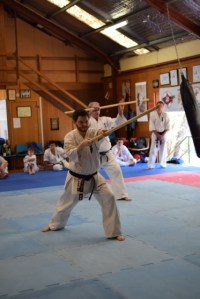
Correct visual focus transfers into other sports and disciplines, as Sempai Alex shows here in Kobudo.
When a beginner is taught to ski, snowboard or wakeboard, they are instructed not to look down at their skis or snowboard, and instead to look up at where they wish to go. Similar to karate, the rationale behind this is to ensure correct posture. In skiing, without the correct posture, weight distribution on the skis will be wrong and will impede control of the skis. In wakeboarding, focusing the eyes on the wakeboard will result in a downward looking posture, which will result in a nose-dive crash.
Another reason why in skiing (and many other high-speed sports) one is taught to focus on where they wish to go, is that the body will naturally orientate towards their point of visual focus. Conversely, if an obstacle is to be avoided, visual focus should not be on the obstacle, otherwise the body will naturally orientate towards the obstacle and will result in a collision. Similarly in mountain biking, when a rider must traverse a gully by crossing a narrow bridge, the rider must not focus on the gully below the bridge, otherwise they will inevitably end up in the gully.
In horse riding, balance and neutral body position is crucial. Horses are trained to respond to the slightest change in the rider’s posture. Slightly leaning forward or back is interpreted by the horse as a command to speed up or slow down. Maintaining a neutral body position is therefore important to avoid an unintentional command. A novice horse rider will be taught to look up in the distance at where they wish to go, which maintains the correct body position. They will also constantly be reminded not to look down at their hands holding the reins or at the horse’s head, as these will cause a forward leaning posture, sending an undesired command to the horse. Correct visual technique is vital in all of these pursuits.
Mokuso – absence of visual focus
Students reflect at the end of training.
Another important part of karate is ‘mokuso’ or meditation, at the beginning and end of training. During mokuso, the karateka closes their eyes and focuses on the training they are about to embark upon or reflects on the training they have just undertaken. In the context of this essay on the importance of correct visual focus, closing of the eyes may seem contradictory. This is not the case. Mokuso does not involve looking outwards, but instead is a practice of looking inwards, and translated literally, means ‘looking into the heart’. This practice of introspection is aided by blocking out all distractions and therefore warrants closing the eyes. This is the only instance in karate when visual focus is not necessary, and the closing of the eyes is required.
Closing
If you see, your body will follow.
Correct visual focus must be trained well in karate. It ensures good posture and balance, assists with breathing and energy flow, provides a frame of reference, guides movements, and provides perceptive vision when sparring. Proficiency in many other sports also requires correct visual focus. When problems arise in training, you (the karateka) should consider and analyse your position and technique, but most importantly, you should think about your eyes. Are your eyes focussing in the right direction? Are you leading your body with your eyes? Are you allowing your eyes to see the whole picture?
A widely read and respected book on personal improvement, The 7 Habits of Highly Effective People, written by Stephen Covey, pronounces the importance of envisioning what you want to achieve in the future, so that you know clearly now what to make a reality. It is known as the 2nd habit: ‘begin with the end in mind’. This is important in all aspects of life. In karate, one must ‘begin with the end in sight’. If you see, your body will follow.
The first session of the seminar was held on Friday night October 30th, at Shihan Howard Lipman’s (8th Dan Kyokushin, 7th Dan Kobudo) Turramurra Dojo. The class was focused on self-defence against an armed assailant, specifically against a hand gun, and later a knife. Ray of Dynamic Defence, a Krav Maga organisation, was the guest instructor at Shihan Lipman’s invitation.
This slideshow requires JavaScript.
After a warm-up and a fitness session, Ray ran the class through various disarming drills that focused on the principles of defence against an assailant wielding a pistol. After going through the basics of gun work, the class turned to knife defence.
Ray’s class was enjoyed by all present. While the karateka only had time to learn the elementary steps of these drills, they got a great sample of the defence skills being taught. KIMAA hopes to have a class with him again in the future.
After the class, a group dinner was enjoyed at Noodle City in Gordon.
The seminar began with basic training, followed by sanbon kumite (or ‘three-step sparring’). The sanbon kumite gradually increased in intensity, using takedowns and counters from bunkai to develop more advanced defensive manoeuvres.
This slideshow requires JavaScript.
This Saturday session included some of the more senior grades from Knox Karate.
The training progressed until lunch, with seniors challenged to come up with their own self-defence combinations while working with a partner.
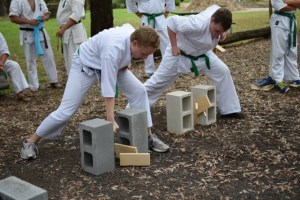
After a BBQ lunch, cooked by Sensei Mark McFadden and prepared by Shihan Cunningham’s wife, Kirsti, the seminar moved on to tameshiwari (board breaking).
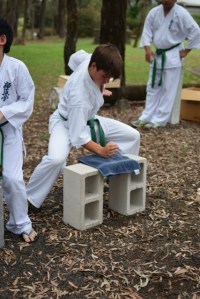
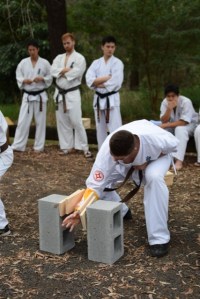
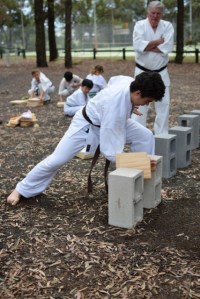
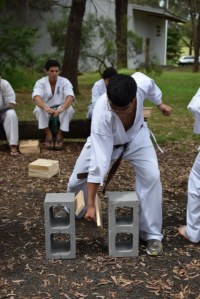
Kyu grades performed single, double and triple board breaks on wood placed on besser blocks, depending on their specific grading requirements.
Sempai Ben Ng and Sempai Don Cheong performed two multi-breaks (breaking four handheld boards with four consecutive techniques) as part of their grading syllabus. Sempai Mark Long and James Ruprai also performed a multi-break. Sempai Wally Gray then showed the younger generation how it’s done by breaking four boards at once with seiken (forefist) and shuto (knife hand) techniques.
Saturday’s training finished with fitness and fight training. Shihan Cunningham hosted a dinner for senior grades and the guests from other dojos at his house after training.
Saturday Group Shot
The senior grading began at 9am on the Sunday morning. Sensei Peter Olive (4th Dan Kyokushin, 1st Dan Kobudo) led the grading while Shihan Lipman and Shihan Cunningham assessed the performance of the students.
This slideshow requires JavaScript.
After the basics segment of the grading was completed, the karateka student body was broken up into groups. Those grading remained in the dojo, while Yudansha and Kyu grades not being graded went outside to do belt-specific training.
Sensei Mark McFadden, Sensei Jon, Sempai Rob, Sempai Mark Long (2nd Dan Kyokushin), Sempai James Campbell (2nd Dan Kyokushin, 2nd Dan Kobudo) and Sempai Alex Lloyd (2nd Dan Kyokushin, 1st Dan Kobudo) revised black belt katas, including Seipai, Okinawan Seipai and Sushi Ho.
Sensei Mark Shelmerdine (4th Dan Kyokushin, 4th Dan Kobudo) took the brown belts through Pinan Sono Go, Gekusai Dai and Yansu.
Sensei James Sidwell (4th Dan Kyokushin, 1st Dan Kobudo) took Nalin, 4th Kyu, through Gekusai Sho and Pinan Sono San.
The senior grading continued inside with advanced techniques, moving through stances, kata, bunkai, and fitness. The senior Kyu grades and black belts attempting the grading were Sempai Ben Ng, Sempai Don Cheong, Sempai Wally Gray, Josh Darley, Victor Sweeney, Patricia Tan and Jermaine Downs.
This slideshow requires JavaScript.
Finally, the grading culminated with kumite (sparring). It was the longest part of the morning for those grading, with Josh and Victor completing 20 fights to meet their syllabus requirements.
Wally
Hieu
Chris
Congratulations to all those who participated in the grading. Belts and certificates will be awarded to students by their instructors over the coming weeks. Extra special congratulations to our newly promoted black belts: Sensei Ben Ng (3rd Dan Kyokushin), Sensei Don Cheong (3rd Dan Kyokushin) and Sempai Wally Gray (2nd Dan Kyokushin).
The weekend did not end after the grading, however. After another lunch prepared by Kirsti, students were broken up into groups based on their Kobudo experience for weapons training. Bo, Sai, Eeku and Arnis (Escrima Sticks) were covered for the remainder of the afternoon.
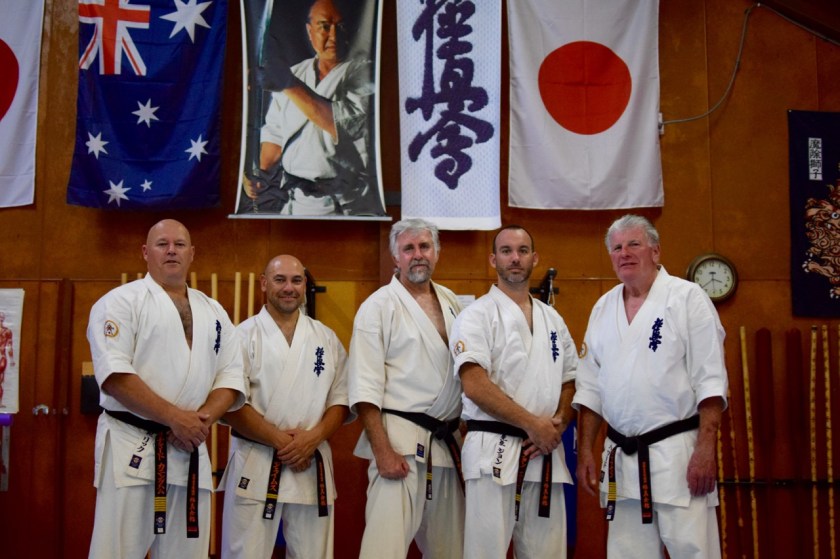
KIMAA Black Belts: Sensei Mark McFadden, Shihan Rick Cunningham, Sensei Jon Ellis, Sempai Rob James, Sensei Ben Ng, Shihan Howard Lipman, Sensei Don Cheong, Sempai Alex Lloyd, Sensei Mark Shelmerdine, Sempai James Campbell, Sempai Mark Long, Sensei Peter Olive & Sensei James Sidwell
It was a tiring but successful weekend. It is always a productive and worthwhile exercise to bring all the dojos together: students get to train with karateka outside their own dojo, and all get to check that their techniques are matching the required KIMAA standard. Thanks to Sempai Alex Lloyd and Jonathan Lee for the photography and videos. Special thanks to everyone who travelled to Sydney for the occasion and, as always, to Shihan Howard Lipman and Shihan Rick Cunningham for organising the weekend.
KIMAA Dojo Operators: Shihan Rick Cunningham (Annangrove), Sempai Rob James (Aspley), Sensei Mark McFadden (Lismore), Sensei Jon Ellis (Ballina) & Shihan Howard Lipman (Turramurra)Shihan Rick Cunningham & Shihan Howard Lipman
KIMAA students from NSW Far North Coast dojos Lismore and Ballina, and from Brisbane’s Aspley Dojo, competed in a National All Styles competition on October 18th. The competition was the NAS Queensland State Titles.
KIMAA competitors at the NAS QLD State Titles.
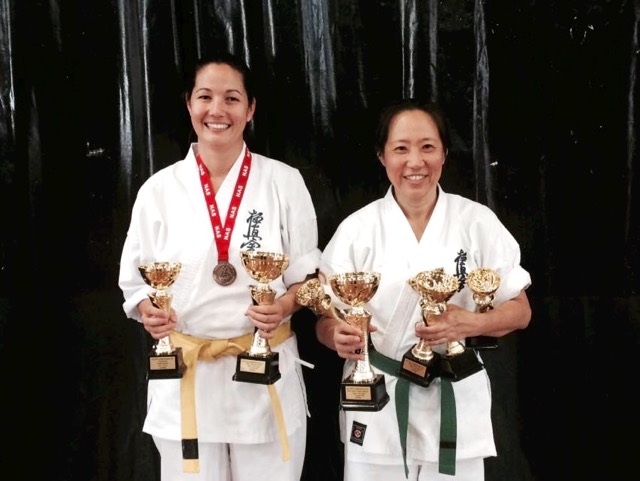
Karateka competitors included Amanda and Jack from Brisbane, and Ayla, Cooper, Conrad, Brad, Liem, Loc, Isaac, Yaco, Wes, Lachlan and Patricia from the North Coast.
Patricia Tan competed in multiple divisions, demonstrating her skills in both Kyokushin and Kobudo. Trish competed in:
Kyu Grade Kata (2nd Place)
Traditional Weaponry Kata (3rd Place)
Kyu Grade Point Sparring (3rd Place)
Trish also teamed up with Amanda Bolger for a partnership entry in two demonstration events: Creative Weaponry Demo and Creative Form Demo. The pair came 1st in both categories. Amanda also placed Second in her Points Sparring division and Fourth in Individual Kata.
Young Aspley Little Lion Jack Bolger did his dojo proud. Jack represented Kyokushin by competing in the Continuous Sparring 7-9 Years. He was eliminated in the first round, but came back to compete in the Points Sparring 8-9 Years. He won a round but was knocked out in the second. This is Jack’s first tournament and he is going from strength to strength, showing excellent character and endurance to face up after a loss and keep pushing.
Congratulations also go to young Cooper from the North Coast, who came fourth in his sparring division.
This slideshow requires JavaScript.
A big round of applause to everyone who participated in the tournament. As Sensei Mark McFadden remarked, ‘It’s not the trophies – it’s the participation, it’s overcoming the fears of getting up in front of everyone or standing up to fight someone. Osu and well done.’
A senior kata class was held at Turramurra Dojo on Saturday October 10th. Shihan Howard Lipman (8th Dan), Shihan Rick Cunningham (6th Dan) and Sensei Peter Olive (4th Dan) were instructing on the day.
KIMAA black belts from Turramurra and Annangrove (and young 2nd Kyu Josh Darley) attended the training session. Sensei Jon Ellis (3rd Dan), head instructor of Ballina Dojo, also made it down for the weekend.
The session focused on a number of black belt katas. Particular focus was given to studying Seipai, Kanku Dai and Sushi Ho. The correct technical execution, bunkai, kiai and timings (with and without count) were heavily emphasised.
Left to right: Sempai James Campbell, Sempai Don Cheong, Sensei Jon Ellis, Sempai Ben Ng, Sensei Peter Olive, Sensei Mark Shelmerdine, Sensei Idir Bahamid, Sempai Mark Long, Sensei Paul Finnerty, Sempai Alex Lloyd, Shihan Rick Cunningham, Shihan Howard Lipman, Joshua Darley.Thank you to Shihan Lipman for hosting the day.
Normal Sydney Kobudo training followed on Sunday the 11th, with Sensei Jon also in attendance. It’s always a pleasure to have other KIMAA practitioners from other dojos training with us.
Round 1 got underway promptly at 10 am. Aaryan Sahukhan and James Parasyn in the ‘Boys 11-13 years under 40kg’ division were up first. It was Aaryan’s first tournament. He showed great spirit, but his more experienced opponent won the match. James used his high kicks to keep his opponent away, scoring points quickly and progressing to Round 2.
Next up was the ‘Men’s Open Middle Weight’ division. Sempai Alex won his fight with aggression and continuous movement. He moved to Round 2, where Sempai Ben and Sempai Don were waiting after both having a bye. The younger years were back to the fighting mats again.
Bernard Wilson, ‘Boys 11-13 years 40-45kg’, held his own against a young black belt from another dojo, but the more advanced fighter won the bout. Next was Kasra Parsanejad, ‘Boys 11-13 years over 45kg’. Kasra had a great first fight, using his height and long legs to overpower his opponent with numerous head kicks.
Andy Kuo of ‘Men’s Novice Heavy Weight’ followed next. Andy copped some heavy hits from his opponent but kept pushing through, winning the round, after two extensions, with gusto. Jasper Choi, ‘Boys 14-15 years 50-57kg’, fought after Andy. Jasper displayed great energy, narrowly losing but still showing the right aggression and pace that a young Kyokushin fighter should have.
Round 2 was the round of extensions and determination. James Parasyn fought hard, narrowly losing to his black belt opponent. His fight went to one extension before the judges could determine a winner, however.
Sempai Don entered Round 2 after his bye, quickly overpowering his opponent. Don used his strong leg techniques and relentless chasing to out-muscle his opponent, earning his place in the Finals for the ‘Men’s Open Middle Weight’ division.
After his win in Round 1, Sempai Alex came up against Sempai Ben, who’d had a bye. The two exchanged many blows: Ben’s trademark strong side and thigh kicks against Alex’s punching barrage and uppercuts. It was a close fight, but Ben’s blocking and fast leg techniques ultimately prevailed. After two exhausting two-minute extensions, the judges finally declared a winner, giving the fight to Sempai Ben.
Kasra fronted up to his second fight in the ‘Boys 11-13 years over 45kg’ division. Kasra again used his height and kicks techniques to great effectiveness, giving him another win.
The final round of fights saw the placement play-offs and finals. Sempai Alex was up first against the opponent Sempai Don and beaten in Round 2. Alex used his aggression and strength to overpower his opponent. The referee awarded Alex the match after he scored two waza-ari, securing Alex as Third Place in the ‘Men’s Open Middle Weight’ division.
Elia Parsanejad had her first fight of the day in the final of the ‘Girls 14-15 years over 55kg’ division. Elia had energy and aggression, dominating much of the fight. However, despite her grit and resilience, her opponent won the bout due to scoring waza-ari from well-timed techniques.
Following Elia’s fight was the big event, the final for the ‘Men’s Open Middle Weight’ between Sempai Ben and Sempai Don. Sempai Ben started the fight a bit more tired than Sempai Don after his longer session in Round 2, but both competitors showed nothing but strong resolve and Kyokushin fighting spirit. The two went punch-for-punch, leading to a two-minute extension. Both sides give it their all in the extension, but ultimately Sempai Don’s leg techniques had more power. The fight went to Sempai Don.
The ‘Boys 14-15 years 50-57kg’ division continued in a round robin. Christian Girdham and Jasper Choi both had losses in this division, but faced each other as part of the play-offs. Jasper moved around a lot but Christian’s height gave him the advantage he needed, taking the win. (A video of this fight is not available.)
KIMAA’s last fight in the tournament was Andy Kuo in the ‘Men’s Novice Heavy Weight’. It was a long, hard fight with an extension. Andy took a hit to the groin and the jaw. His opponent won the fight, despite the penalty against him, but Andy couldn’t have done KIMAA any prouder.
Most of the fighters won placements at the end of the day. These included:
Men’s Open Middle Weight champions: Sempai Don (1st), Sempai Ben (2nd) & Sempai Alex (3rd).
Men’s Open Middle Weight
Sempai Don Cheong – 1st
Sempai Ben Ng – 2nd
Sempai Alex Lloyd – 3rd
Men’s Novice Heavy Weight
Andy Kuo – 2nd
Girls 14-15 years over 55kg
Elia Parsanejad – 2nd
Boys 14-15 years 50-57kg
After the tournament.
Christian Girdham – 2nd
Jasper Choi – 3rd
Boys 11-13 years over 45kg
Kasra Parsanejad – 1st
Boys 11-13 years 40-45kg
Bernard Wilson – 2nd
Boys 11-13 years under 40kg
James Parasyn – equal 3rd
KIMAA victors.
Congratulations to everyone involved. Both first-time fighters and the more experienced combatants all displayed great determination and attitude, regardless of the strength and experience of their opponents. Shihan Lipman was very proud of all involved. Having KIMAA take so many placements, including the top three of the ‘Men’s Open Middle Weight’, was an extra special reward for all the hard effort put in by students and instructors alike.
Thanks again to Shihan Lipman, Shihan Cunningham and Sensei James for the coaching support, both on the day and in all the months of training prior.
KIMAA’s next big event will be the October/November Seminar & Grading.



































 Kyokushin International Martial Arts Australia